
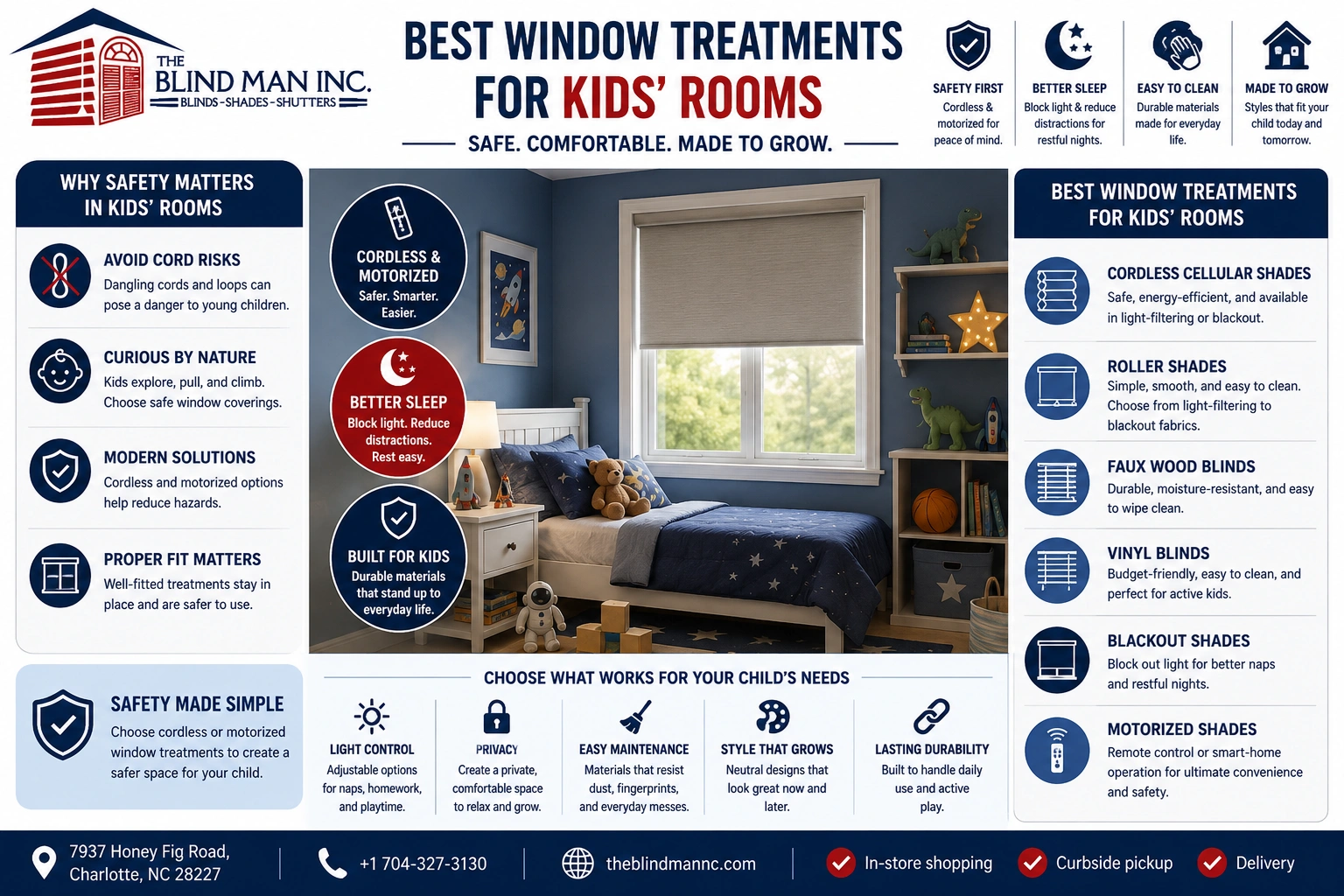
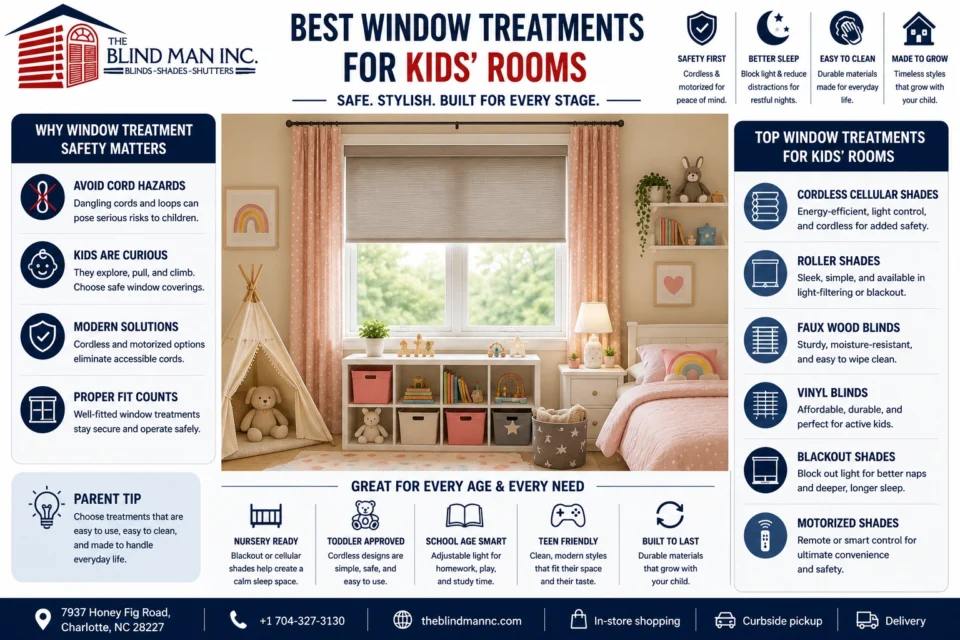
The best window treatments for kids’ rooms are cordless or motorized options that combine safety, privacy, light control, durability, and easy operation. Cordless cellular shades, roller shades, faux wood blinds, vinyl blinds, blackout shades, room-darkening shades, and motorized shades can all work well depending on the child’s age, room layout, and sleep needs.
Children’s bedrooms need window coverings that help create a calm sleep environment while reducing risks from cords, dangling parts, and hard-to-use designs. The right choice should be safe, practical, easy to clean, and flexible enough to keep working as the room changes.
For parents, the right choice is not only about how the room looks. A child’s bedroom should feel comfortable, age-appropriate, and practical for daily life. At The Blind Man Inc., we help families compare window treatment options that support safer spaces, better sleep, and long-term function as children grow.
Why Safety Matters in Kids’ Rooms
Window treatment safety should always be a priority in children’s bedrooms, nurseries, playrooms, and shared family spaces. Children are naturally curious. They pull, climb, reach, and explore, often without understanding what could be dangerous. That is why window coverings in kids’ rooms need to be chosen carefully.
One of the main concerns is accessible cords. Traditional corded blinds and shades may have loops or long pull cords that hang within a child’s reach. These cords can create a safety concern, especially for younger children. Even if a window seems out of reach, nearby furniture can make cords easier for children to access.
Dangling components can also be an issue. Beaded chains, long tassels, loose strings, or unsecured operating parts may attract attention. A child may tug on them, wrap them around objects, or damage the window treatment by pulling too hard.
Difficult-to-operate window coverings are another concern. If a shade is heavy, uneven, or hard to raise and lower, children may try to force it. This can damage the treatment or make it less safe to use. In a child’s room, simple operation matters.
Modern window treatments offer more safety-focused choices for family homes. Cordless designs, motorized shades, and properly fitted window coverings can help reduce accessible cords and loose parts. Parents comparing window treatments for kids’ rooms should focus on cordless operation, proper fit, smooth function, privacy, and the amount of light control the room needs.
A safer window treatment should also fit the window properly. Poorly fitted treatments may leave gaps, hang unevenly, or become easier to pull. In kids’ rooms, a clean fit helps improve appearance, privacy, and everyday safety.
Cordless and Motorized Window Treatments
Cordless and motorized window treatments are popular choices for children’s bedrooms because they remove or reduce the need for hanging cords. They can also make daily use easier for parents and older children.
Cordless Shades
Cordless shades are designed to raise and lower without long pull cords. Many operate by gently lifting or lowering the bottom rail. This makes them a practical option for nurseries, bedrooms, and playrooms.
The main benefit is simplicity. There are fewer visible operating parts, which helps create a cleaner look and a safer setup. Cordless shades can work well for parents who want a straightforward option that is easy to use and maintain.
Cordless designs are available in several styles, including cellular shades, roller shades, Roman shades, and other shade options. The best choice depends on how much light control, privacy, and insulation the room needs.
Motorized Shades
Motorized shades can improve both convenience and safety. Instead of using cords, the shade moves with a remote, wall switch, or compatible smart-home system. This can be especially helpful in children’s rooms where parents want easy control over light and privacy.
Motorized shades are also useful for windows that are hard to reach, such as tall windows, windows behind furniture, or windows in rooms with unusual layouts. Parents can adjust the shades without climbing, stretching, or moving furniture.
Remote-Controlled Operation
Remote-controlled operation is practical for kids’ bedrooms because parents can adjust the room quickly. This is helpful during naps, bedtime, morning routines, or quiet time.
For younger children, parents can keep the remote in a safe place. For older children, remote operation may make it easier for them to control their own room without pulling on cords or handling heavy window coverings.
Smart-Home Integration
Some motorized window treatments can connect with smart-home systems. This allows parents to schedule shades to open in the morning or close at bedtime. It can also help create a more consistent sleep routine.
Smart-home integration is especially helpful for children who benefit from routine. A shade that lowers at the same time every evening can signal that it is time to wind down. In the morning, scheduled opening can help the room feel brighter and more welcoming.
Cordless and motorized options are not only about convenience. They can also create a cleaner, safer, and more practical bedroom environment.
Best Window Treatments for Sleep and Privacy
Children’s bedrooms need window treatments that support rest, comfort, and privacy. Light control is one of the most important factors because outside light can affect sleep routines, nap schedules, and bedtime comfort.
Better Sleep
A room that is too bright may make it harder for children to fall asleep or stay asleep. Early morning sunlight, streetlights, headlights, and nearby outdoor lighting can all interrupt rest.
Blackout shades are often helpful for children who nap during the day or need a darker sleep environment. They block more incoming light than standard light-filtering treatments and can help create a calmer bedroom.
Room-darkening shades are another good option. They do not always block as much light as blackout shades, but they can reduce brightness enough to make the room more comfortable for sleep.
Reduced Outside Distractions
Children can be easily distracted by movement outside the window. Cars, neighbors, pets, and outdoor activity may make it harder to focus, relax, or settle down at bedtime.
Shades, blinds, or layered treatments can limit visibility and reduce outside distractions. This can be helpful for bedrooms that face streets, sidewalks, driveways, or play areas.
Privacy
Privacy matters in every bedroom, but it is especially important in kids’ rooms. A window treatment should prevent clear visibility from outside, especially at night when interior lights are on.
Room-darkening shades, cellular shades, roller shades with privacy fabrics, and layered window treatments can all help improve privacy. The right option depends on the window size, location, and how close the home is to neighbors or shared outdoor areas.
Light Control
Adjustable light control helps the room serve different purposes throughout the day. A child’s bedroom may be used for sleeping, reading, homework, play, and quiet time. Each activity may need a different level of light.
Cellular shades can provide soft light filtering, privacy, and insulation. Blackout cellular shades can add stronger light control for sleep. Roller shades can offer a clean look and are available in different opacity levels. Layered treatments, such as shades with drapery panels, can provide more flexibility.
Proper light control can support healthier sleep routines by making the room darker at night and more comfortable during naps. It can also make the room feel calmer and more private.
Easy-Clean Materials for Kids’ Spaces
Children’s rooms need window treatments that can handle real life. Dust, fingerprints, spills, toys, and everyday wear are all part of a child’s space. For that reason, durability and easy maintenance matter.
Stain Resistance
Some fabrics and materials are better suited for kids’ rooms because they are easier to spot clean. Smooth surfaces are often simpler to wipe down than delicate or heavily textured materials.
Roller shades with durable fabrics, faux wood blinds, vinyl blinds, and some cellular shades can be good choices depending on the room. Parents should consider how often the window treatment may need cleaning and how easy it is to maintain.
Dust Buildup
Dust can collect on slats, fabric folds, and window treatment surfaces. In children’s rooms, simple designs are often easier to keep clean. Roller shades have a smooth surface and fewer areas for dust to settle. Cellular shades can also be maintained with gentle dusting or vacuuming using a soft brush attachment.
Blinds offer adjustable light control, but slats may need more frequent dusting. If choosing blinds for a child’s room, parents may prefer materials that can be wiped clean easily.
Everyday Wear and Tear
Children’s bedrooms are active spaces. Window treatments may be opened and closed often, bumped by toys, or touched throughout the day. Durable materials and smooth operation can help the treatment last longer.
Cordless and motorized options can also reduce wear because they limit pulling, twisting, and uneven handling. When a window covering is easy to use, it is less likely to be forced or damaged.
Low-Maintenance Choices
Good low-maintenance options for kids’ rooms include:
- Cordless cellular shades for soft light control and insulation
- Roller shades for simple cleaning and a clean appearance
- Faux wood or vinyl blinds for wipeable surfaces
- Motorized shades for easy operation and reduced handling
- Layered treatments when more privacy or light control is needed
The right material should match the child’s age, the room’s use, and the parent’s cleaning preferences. A nursery may need soft blackout shades, while an older child’s room may need durable, adjustable treatments that support homework, sleep, and privacy.
Choosing Window Treatments That Grow With the Room
Children’s needs change quickly. A window treatment that works for a nursery should ideally remain useful as the room becomes a toddler’s room, then a school-age child’s bedroom, and eventually a teen’s space.
Neutral Styles
Neutral styles often provide the best long-term value. Soft whites, creams, grays, taupes, and other simple colors can adapt as the room’s bedding, wall colors, toys, and décor change.
A highly themed window treatment may feel fun at first, but it can become outdated as the child grows. A more neutral shade or blind can support different room styles over time.
Adjustable Light Control
As children grow, their light needs change. Babies and toddlers may need darker rooms for naps. School-age children may need filtered daylight for reading or homework. Teenagers may want more privacy and stronger light control.
Adjustable options, such as cellular shades, roller shades, blinds, and motorized treatments, can support these changing needs. Parents can choose a treatment that works for bedtime, daytime play, studying, and privacy.
Long-Term Durability
Durability is important because children’s rooms are used every day. A strong, well-fitted window treatment can reduce the need for frequent replacement.
Parents should consider materials that resist wear, operate smoothly, and are easy to clean. Cordless and motorized options may also help the treatment last longer because they reduce tugging and uneven use.
Flexible Design Choices
Flexible design choices help the room mature without requiring a full update. A simple shade can be paired with new curtains later. A neutral window treatment can work with colorful bedding, wall art, or changing furniture.
Layered window treatments can also offer flexibility. For example, a blackout shade may provide sleep support, while decorative side panels can be updated as the child’s style changes.
Balancing child-friendly features with lasting value is key. The best window treatments for kids’ rooms are safe, practical, comfortable, and adaptable.
FAQs About Window Treatments for Kids’ Rooms
What are the safest window treatments for kids’ rooms?
The safest window treatments for kids’ rooms are typically cordless or motorized options because they reduce or eliminate accessible cords. Proper fit, simple operation, and durable materials also help create a safer bedroom environment.
Are cordless blinds safer than traditional blinds?
Yes, cordless blinds and shades are generally safer than traditional corded options because they do not have long dangling cords within a child’s reach. They also create a cleaner look and are easier for many families to use.
Are motorized shades worth it for children’s bedrooms?
Motorized shades can be worth it for children’s bedrooms because they improve convenience, reduce handling, and eliminate the need for pull cords. They are especially helpful for hard-to-reach windows or families who want scheduled light control.
What window treatments help children sleep better?
Blackout shades, room-darkening shades, and layered window treatments can help children sleep better by reducing outside light. These options are useful for naps, early bedtimes, bright mornings, and bedrooms near streetlights.
Which window coverings are easiest to clean?
Roller shades, faux wood blinds, vinyl blinds, and some cellular shades are often easy to maintain. Smooth surfaces are usually easier to wipe down, while simpler designs collect less dust.
How can I childproof bedroom window treatments?
You can childproof bedroom window treatments by choosing cordless or motorized options, keeping furniture away from windows, avoiding dangling cords or chains, and making sure the treatment fits and operates properly.
Create a Safer, More Comfortable Kids’ Room
The right window treatment can make a child’s bedroom safer, calmer, and more comfortable. Parents should look for options that reduce cord risks, support healthy sleep, provide privacy, and stand up to daily use.
At The Blind Man Inc., we help families choose window treatments that fit children’s rooms now and continue working as their needs change. Whether you are designing a nursery, updating a child’s bedroom, or improving privacy and light control, the right choice can support both safety and comfort every day.
Share this article
Latest articles

October 13, 2026
October 13, 2026

October 13, 2026