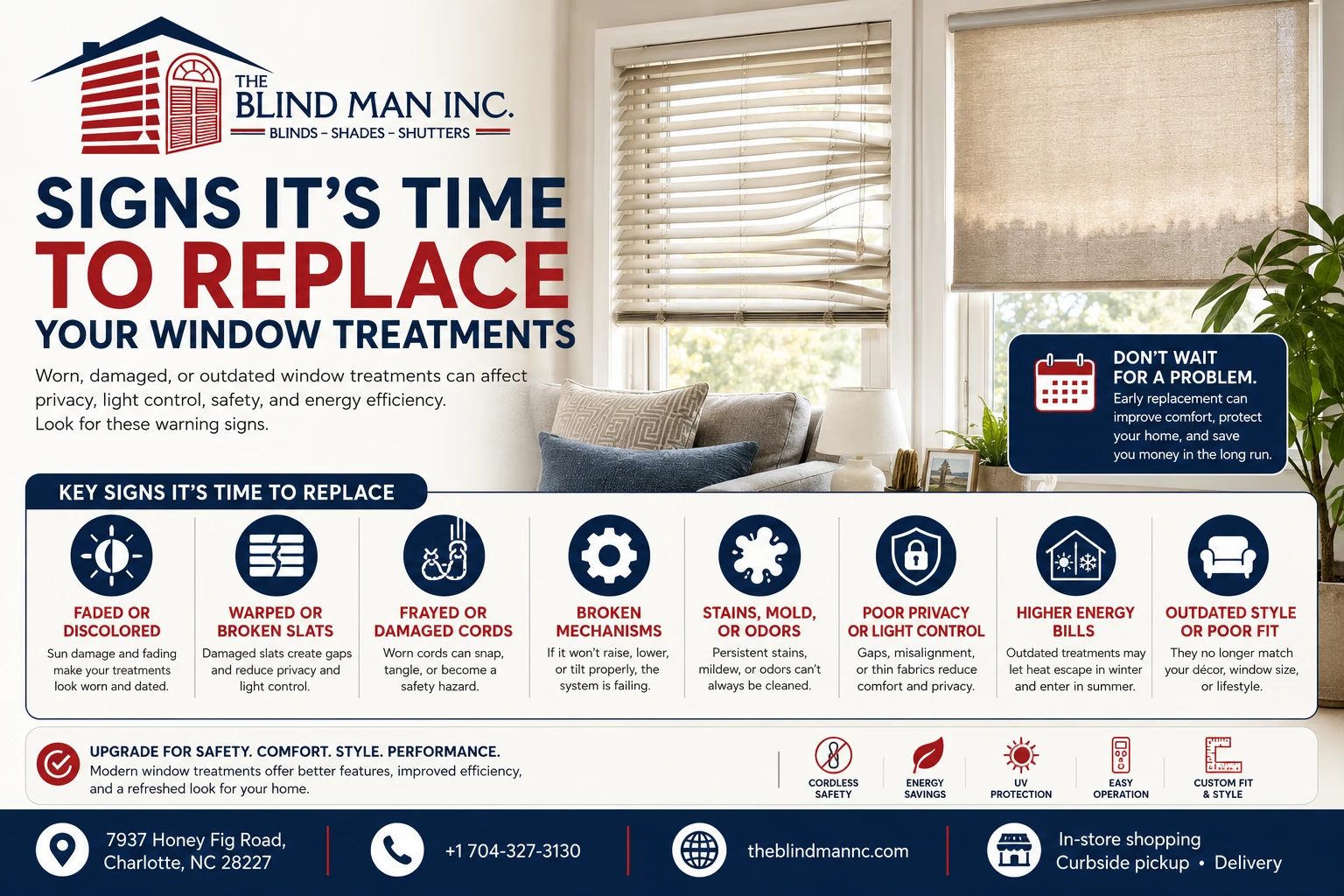
Window treatments should be replaced when they no longer operate safely, provide adequate privacy, control sunlight effectively, or complement the needs of the room. Visible damage, repeated repair problems, faded materials, and outdated features are all signs that replacement may offer better long-term value than another temporary fix.
Knowing when to replace window treatments is not always straightforward. Blinds, shades, shutters, and drapery often deteriorate gradually, which makes it easy to overlook declining performance. Everyday use, strong sunlight, humidity, dust, changing décor, and normal wear can all shorten their useful life.
Regular inspection can help homeowners catch problems before a broken cord, damaged slat, or failing lift system becomes inconvenient or unsafe. It can also make it easier to decide whether a repair is worthwhile or whether an upgrade would provide better comfort, appearance, and performance.
What Is the Average Lifespan of Window Treatments?
The lifespan of a window treatment depends on its material, construction quality, location, maintenance, and frequency of use. A treatment installed in a rarely used guest room may last longer than one opened and closed several times a day in a living room or kitchen.
As a general guideline:
- Basic vinyl blinds may last 5 to 8 years
- Aluminum blinds may last 7 to 10 years
- Fabric shades may last 7 to 10 years
- Cellular shades may last 7 to 12 years
- Wood or faux wood blinds may last 8 to 15 years
- Plantation shutters may last 15 to 25 years or longer
- Custom drapery may last 8 to 15 years
These estimates are not firm replacement deadlines. Well-made window treatments can last longer when they are maintained properly and protected from moisture, excessive heat, and rough operation.
The surrounding environment also matters. Charlotte, NC, experiences strong sunlight, warm summers, and periods of high humidity. Direct sun can fade fabric, dry out wood, discolor vinyl, and weaken certain materials over time. Humidity may also contribute to warping, mildew, swelling, or mechanical wear in bathrooms, kitchens, and sunrooms.
Age alone does not mean a window treatment must be replaced. Performance and condition are usually more important indicators.
What Are the Warning Signs It’s Time for a Replacement?
Some problems are mainly cosmetic, while others affect safety, function, privacy, or energy efficiency. Homeowners should look at the entire window treatment rather than focusing only on one damaged part.
Faded or Discolored Materials
Sunlight naturally fades many fabrics, wood finishes, and synthetic materials. Mild fading may not affect operation, but severe or uneven discoloration can make a room look worn and dated.
Fading may be especially noticeable when:
- One side of the room receives stronger sunlight
- Furniture has been rearranged
- Shades are frequently left in the same position
- The treatment no longer matches nearby décor
- Fabric has developed yellow or bleached areas
Heavy fading may also indicate that the material has weakened. Fabric can become brittle, and plastic components may crack more easily after years of UV exposure.
Warped, Bent, or Cracked Slats
Blinds and shutters depend on straight, properly aligned slats or louvers. Once multiple pieces become warped, cracked, bent, or broken, the treatment may no longer close evenly.
Damaged slats can create gaps that reduce privacy and light control. They may also prevent the entire unit from raising, lowering, or tilting smoothly.
A single damaged slat may be repairable. Widespread deterioration usually makes replacement more practical.
Frayed, Tangled, or Damaged Cords
Cords experience significant wear because they carry tension every time a blind or shade is operated. Fraying, stiffness, tangling, or uneven movement may indicate that the cord system is failing.
Damaged cords can cause the treatment to:
- Raise unevenly
- Become stuck in one position
- Drop unexpectedly
- Tilt incorrectly
- Require excessive force to operate
Older corded treatments may also present safety concerns in homes with children or pets. Modern cordless and motorized options can reduce these risks while making daily operation easier.
Broken Lift or Tilt Mechanisms
If a window treatment will not stay raised, lower completely, tilt correctly, or roll smoothly, the internal mechanism may be worn or damaged.
Common signs include:
- Clicking or grinding sounds
- A shade that rolls up crooked
- Blinds that slip down after being raised
- A wand that spins without moving the slats
- A roller that no longer retracts
- A motor that hesitates or stops
Minor hardware problems may be repairable, but repeated mechanical failure often signals that the system is near the end of its useful life.
Broken Brackets or Loose Hardware
Brackets, screws, headrails, and mounting hardware can loosen over time. This may cause the treatment to shift, rattle, sag, or pull away from the wall or window frame.
A loose screw may be easy to correct. Cracked brackets, damaged mounting surfaces, or a bent headrail may require more extensive work.
Any window treatment that appears unstable should be inspected promptly. Heavy shades, shutters, and blinds can cause injury or property damage if they detach.
Permanent Stains, Mold, or Odors
Light dust and small marks can often be removed with proper cleaning. However, permanent stains, persistent odors, mildew, or widespread discoloration may make replacement the healthier and more practical option.
Moisture-related damage is common near:
- Bathroom windows
- Kitchen sinks
- Laundry rooms
- Poorly insulated windows
- Areas with recurring condensation
- Rooms with inadequate ventilation
Mold that returns after cleaning may indicate an unresolved humidity or window issue. The source of the moisture should be addressed before new treatments are installed.
Reduced Privacy
Window treatments should provide the intended level of privacy when closed. Gaps, stretched fabric, broken slats, damaged louvers, and misaligned panels can expose parts of the room.
Privacy may also decline when the original product no longer fits the homeowner’s needs. For example, a light-filtering shade may have worked well in a living room but may not provide enough privacy after the space becomes a bedroom or home office.
Poor Light Control
Blinds and shades should help manage glare, brightness, and direct sunlight. If they no longer close fully or allow uncomfortable light through damaged areas, replacement may restore better control.
Changing technology and room use can also affect light-control needs. Homeowners working from home may need better glare reduction for computer screens, while media rooms may benefit from room-darkening treatments.
Declining Energy Efficiency
Older window treatments may provide limited insulation compared with newer designs. Gaps around the treatment, warped materials, and poorly fitted products can allow more heat to enter during summer and escape during winter.
Signs of declining performance may include:
- Rooms becoming unusually hot in direct sunlight
- Cold areas near windows
- Increased glare during certain hours
- Furniture or flooring fading more quickly
- Frequent HVAC adjustments
- Uneven indoor temperatures
Window treatments cannot correct every insulation problem, but well-fitted cellular shades, shutters, lined drapery, and other modern options may improve comfort near windows.
Outdated Style or Poor Fit
A window treatment can still function but feel visually outdated. Old colors, heavy patterns, yellowed materials, oversized valances, or mismatched treatments may make a room feel less cohesive.
Poor fit is another concern. Treatments may no longer fit correctly after window replacement, remodeling, trim changes, or moving them from one room to another.
Replacement can be reasonable when a treatment no longer fits the window, décor, or purpose of the space.
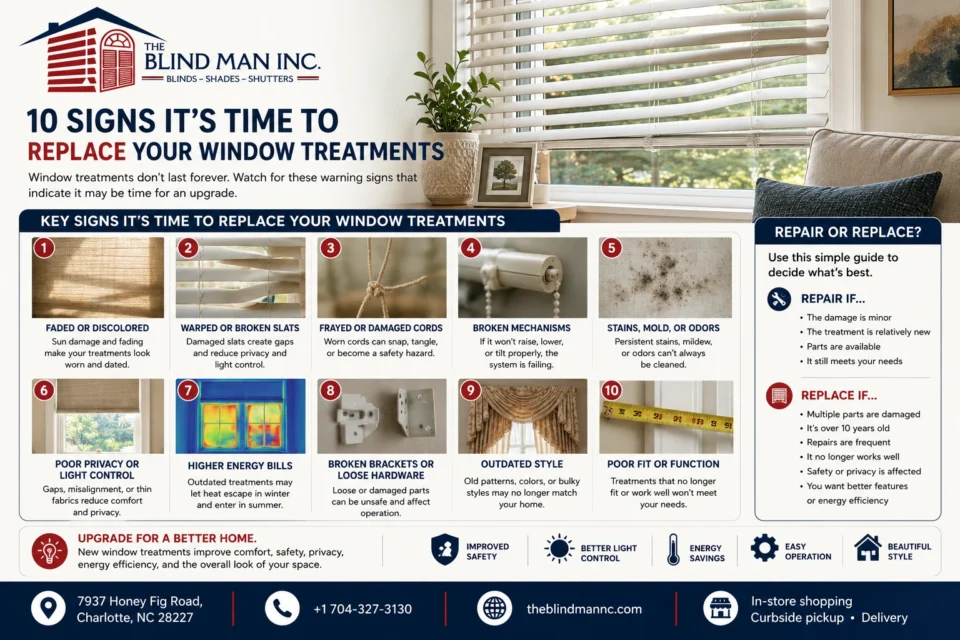
Should You Repair or Replace Your Window Treatments?
Repair is often worthwhile when the treatment is relatively new, structurally sound, and affected by one isolated problem. Replacement usually makes more sense when damage is widespread, parts are unavailable, or repeated repairs are becoming costly.
Repair May Be Appropriate When:
- One slat or louver is damaged
- A bracket has come loose
- A cord needs restringing
- A wand or tilt control is broken
- A roller needs minor adjustment
- The fabric is clean and in good condition
- Replacement parts are readily available
- The treatment still meets the room’s needs
Simple repairs can restore function and extend the life of a quality product.
Replacement May Be Better When:
- Several parts are damaged
- The treatment is more than a decade old
- Repairs have already been completed multiple times
- The fabric is faded, stained, or deteriorated
- The mechanism fails repeatedly
- Replacement parts are discontinued
- The treatment presents a safety concern
- The product no longer provides adequate privacy or light control
- New windows have changed the required measurements
- The homeowner wants cordless, motorized, or energy-efficient features
Homeowners should also compare repair costs with the expected remaining lifespan. Paying for a major repair on a heavily worn treatment may only delay replacement for a short time.
A professional inspection can help identify whether the damage is limited to one part or reflects broader wear throughout the system.
What Are the Benefits of Upgrading to New Window Treatments?
Replacing outdated treatments is not only about improving appearance. Modern products may offer better safety, comfort, control, and convenience.
Improved Cord Safety
Cordless window treatments reduce exposed loops and hanging cords. This can make them a safer choice for households with children and pets.
Cordless systems can also create a cleaner appearance and simplify operation. Many shades can be raised or lowered by gently moving the bottom rail.
Motorized Operation
Motorized blinds and shades can be controlled through a remote, wall switch, smartphone, or compatible smart-home system.
Motorization may be especially useful for:
- Tall windows
- Hard-to-reach windows
- Large groups of windows
- Homeowners with limited mobility
- Bedrooms and media rooms
- Scheduled light and privacy control
Automated scheduling can also help manage sunlight while homeowners are away.
Better Insulation
Modern window treatments may help reduce heat transfer around windows. Cellular shades, shutters, lined drapes, and layered treatments can create an additional barrier between the room and the glass.
The level of insulation depends on the product, material, fit, and installation. While window treatments do not replace proper windows or insulation, they can contribute to a more comfortable interior.
Improved UV Protection
Strong sunlight can fade flooring, rugs, furniture, artwork, and upholstery. New solar shades, lined treatments, and UV-filtering materials may provide better protection while still allowing homeowners to control natural light.
This can be particularly valuable in Charlotte homes with large south- or west-facing windows.
Easier Operation
Worn treatments often become difficult to lift, tilt, or close. New systems generally operate more smoothly and require less force.
Easier operation encourages homeowners to use treatments more consistently for privacy, glare reduction, and temperature control.
Better Privacy and Light Management
Modern window treatments are available in a wide range of opacity levels and configurations. Homeowners can select materials based on the needs of each room rather than relying on the same treatment throughout the home.
Options may include:
- Light-filtering shades
- Room-darkening shades
- Blackout treatments
- Top-down, bottom-up shades
- Adjustable shutters
- Solar shades
- Layered treatments
This flexibility makes it easier to balance daylight, views, and privacy.
Updated Design
New treatments can help refresh a room without a full renovation. Current designs often feature cleaner lines, neutral fabrics, natural textures, concealed hardware, and finishes that coordinate with modern interiors.
A properly measured treatment also looks more finished than one that is too narrow, too long, or unevenly mounted.
When Should You Schedule a Professional Consultation?
Homeowners may want to schedule a consultation when they are unsure whether existing treatments can be repaired safely or when several windows need attention.
Professional guidance may be useful when:
- Multiple window treatments are failing
- Measurements are unusual
- Windows are very large or high
- Motorized treatments are being considered
- The home has children or pets
- Energy efficiency is a priority
- Existing treatments do not provide enough privacy
- Sunlight is damaging floors or furniture
- Materials are warped, moldy, or heavily faded
- Replacement products must coordinate across several rooms
A consultation can also help homeowners compare different treatment types without relying only on appearance. A professional can evaluate window direction, room use, sunlight exposure, privacy needs, operating preferences, and existing décor.
This is particularly important when treatments look similar but perform differently. A fabric that works well in a bedroom may not be suitable for a humid bathroom or a sunny home office.
There is no need to wait until a window treatment fails completely. Early evaluation can prevent a damaged system from becoming stuck, falling, or becoming unsafe to operate.
How The Blind Man Can Help
The Blind Man can help homeowners evaluate the condition, safety, fit, and performance of existing window treatments. The purpose of an evaluation is to determine whether a small repair can restore the treatment or whether replacement would offer better long-term value.
Homeowners can receive guidance based on the specific window, room, light exposure, and daily needs of the household. This may include identifying worn mechanisms, measuring unusual windows, comparing cordless or motorized systems, and selecting materials suited to Charlotte’s sunlight and humidity.
When replacement is appropriate, homeowners can explore Window Treatments that provide the desired balance of privacy, light control, insulation, ease of use, and design.
Not every faded slat or loose bracket requires a complete upgrade. A knowledgeable assessment helps homeowners avoid unnecessary replacement while recognizing when continued repairs are unlikely to solve the underlying problem.
FAQs
How often should window treatments be replaced?
Many window treatments last between 7 and 15 years, although shutters and other durable products may last much longer. Replacement should be based on condition, safety, performance, and changing household needs rather than age alone.
Can old blinds be repaired?
Yes, some old blinds can be repaired if the damage is limited to a cord, bracket, wand, or individual slat. Repair may be difficult when parts are discontinued or the headrail and lift system are heavily worn.
Are faded window treatments still effective?
Mild fading may be cosmetic, but severe fading can indicate UV deterioration. Brittle fabric, cracked slats, and weakened finishes may reduce durability and affect how evenly the treatment filters light.
Should I replace all window treatments at the same time?
Not necessarily. Homeowners can replace treatments room by room or prioritize the most damaged and frequently used windows. Matching treatments across visible areas may create a more consistent appearance.
Are cordless blinds safer than corded blinds?
Cordless blinds and shades reduce exposed operating cords, making them a safer option in homes with children or pets. They also offer a cleaner look and are often easier to operate.
Can new window treatments help reduce energy costs?
Some treatments may help reduce heat gain and heat loss near windows. Cellular shades, shutters, lined curtains, and properly fitted products can improve comfort, although results depend on the window and installation.
When should damaged shutters be replaced?
Shutters may need replacement when multiple louvers are broken, frames are warped, panels no longer close correctly, or moisture damage has weakened the material. Minor hinge or louver damage may be repairable.
Why do blinds become difficult to raise?
Blinds may become difficult to raise because of worn cords, damaged pulleys, uneven tension, internal friction, or a failing lift mechanism. Forcing them can cause further damage.
Can window treatments become outdated even if they still work?
Yes. Treatments may no longer meet current safety, privacy, energy-efficiency, or design needs. Home renovations, new furniture, changing room use, and smart-home upgrades may also make older products less suitable.
Is professional measurement necessary for replacement window treatments?
Professional measurement can be helpful for unusually shaped, oversized, recessed, or closely grouped windows. Accurate measurements reduce gaps, uneven mounting, and operational problems.
Share this article
Latest articles
October 24, 2026
October 24, 2026

October 24, 2026