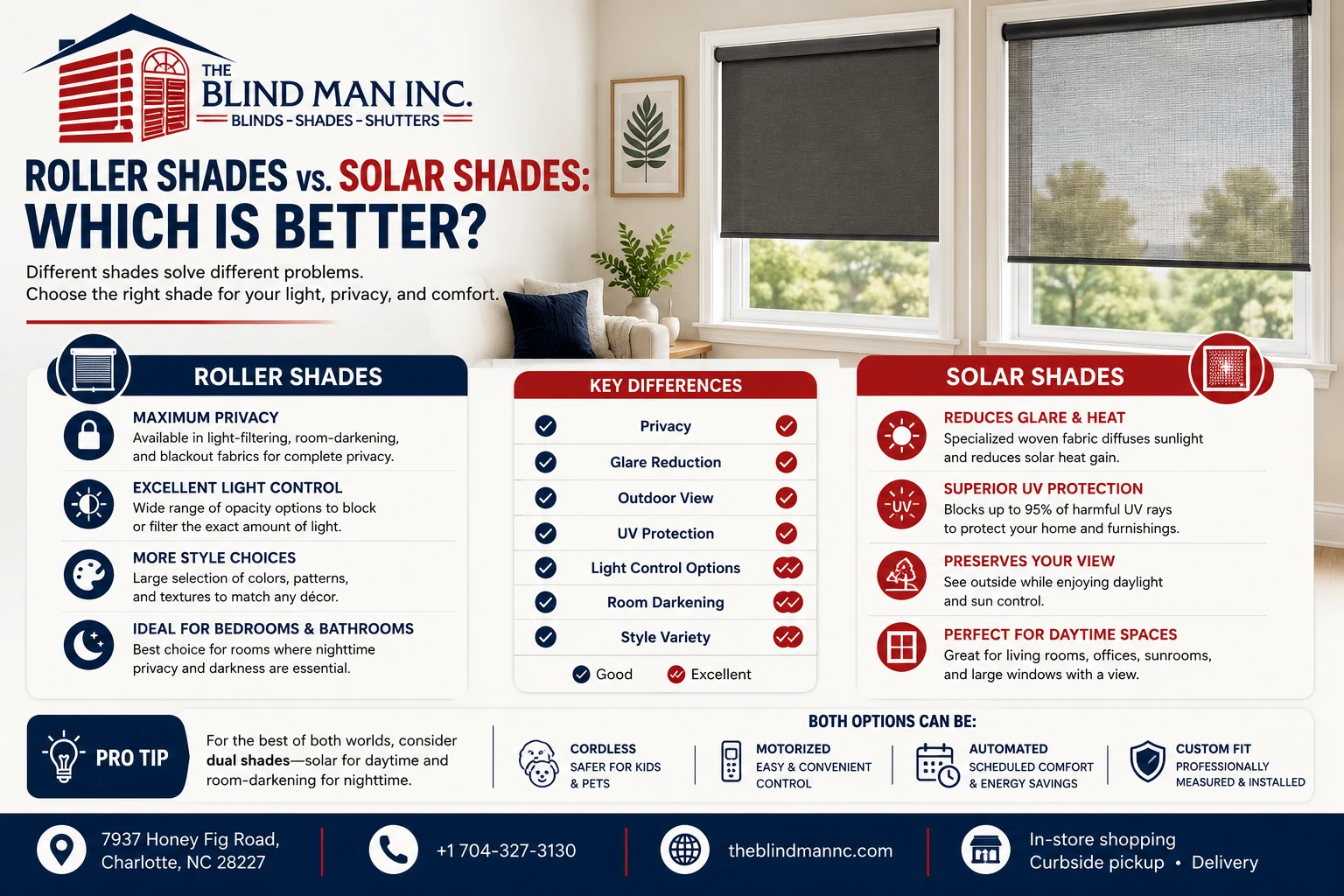
The better choice between roller shades and solar shades depends on whether privacy or sun control matters most. Roller shades generally provide stronger privacy and room-darkening options, while solar shades are designed to reduce glare, filter UV rays, and preserve daytime views.
Although the two styles look similar, they perform differently. Both use a flat panel of fabric that rolls neatly around a tube, but the material used determines how much light, heat, and visibility pass through the shade.
Understanding the differences between roller shades vs solar shades can help homeowners choose a treatment that suits each room rather than using one style throughout the entire home.
What Are the Key Differences Between Roller Shades and Solar Shades?
Roller shades and solar shades share a clean, streamlined appearance. When raised, both roll into a compact tube above the window. When lowered, they provide a smooth panel without slats, louvers, or bulky folds.
The primary difference is the fabric.
Roller Shades
Roller shades are available in a broad selection of decorative and functional fabrics. Depending on the material selected, they can provide light filtering, privacy, room darkening, or near-blackout performance.
Common roller shade fabrics include:
- Light-filtering textiles
- Decorative woven materials
- Vinyl-coated fabrics
- Room-darkening fabrics
- Blackout fabrics
- Textured and patterned materials
Because roller shades come in many opacity levels, homeowners can select a fabric based on how much light and privacy they want.
A light-filtering roller shade may soften daylight while reducing direct visibility into the room. A blackout roller shade can block most incoming light and provide substantially stronger privacy.
Solar Shades
Solar shades are made from specialized woven fabric designed to manage sunlight. Their main purpose is to reduce glare, limit UV exposure, and decrease solar heat while maintaining some visibility through the window.
Solar fabrics are usually categorized by openness factor. The openness percentage indicates how tightly the material is woven.
A lower openness factor has a tighter weave and generally provides:
- Greater glare reduction
- More UV protection
- Less visibility through the fabric
- A darker view
A higher openness factor has a looser weave and generally provides:
- Better outdoor visibility
- More natural light
- Less privacy
- Lower glare reduction
Solar shades are often chosen for large windows, sunrooms, home offices, and living areas where homeowners want sun protection without completely covering the outdoor view.
Privacy and Visibility
Roller shades can provide complete privacy when made with opaque or blackout fabric. Solar shades offer limited daytime privacy but may allow people outside to see into the home after dark when interior lights are on.
Light Control
Roller shades offer a wider range of light-control options. Solar shades primarily filter and diffuse bright sunlight rather than blocking it completely.
UV Protection
Solar shades are specifically designed to reduce UV exposure. Roller shades may also block UV rays, but their performance depends on the selected fabric.
Appearance
Both styles offer a contemporary, uncluttered look. Roller shades are available in a wider variety of colors, patterns, and textures, while solar shades tend to have a more uniform woven appearance.
Maintenance
Both treatments are generally easy to maintain. Routine dusting or light vacuuming is usually sufficient.
Solar shade fabric should be cleaned carefully to avoid damaging its weave. Roller shade cleaning requirements vary by fabric, particularly when decorative textiles are used.
Motorization
Both roller shades and solar shades can be motorized. Motorized operation is useful for high windows, large window groups, hard-to-reach locations, or homeowners who want scheduled shade control.
Which Option Provides Better Privacy?
Roller shades generally provide better privacy than solar shades.
An opaque roller shade blocks direct visibility through the fabric during the day and at night. Blackout roller shades provide even greater coverage, although small light gaps may remain around the edges depending on how the shade is mounted.
Solar shades provide different privacy levels depending on lighting conditions.
Solar Shade Privacy During the Day
During daylight hours, solar shades can limit visibility from outside when the exterior is brighter than the interior. People inside may still be able to see through the fabric and enjoy the outdoor view.
However, solar shades should not be considered complete privacy treatments. Shapes, movement, and interior details may remain visible depending on the openness factor and surrounding light.
Solar Shade Privacy at Night
At night, the privacy effect reverses. When interior lights are on and it is dark outside, people outdoors may be able to see through the shade into the room.
For this reason, solar shades are usually not the best stand-alone choice for bedrooms, bathrooms, or street-facing rooms where nighttime privacy is essential.
Privacy Solutions for Solar Shades
Homeowners who want the daytime benefits of solar shades can pair them with another treatment, such as:
- Drapery panels
- An additional roller shade
- Interior shutters
- Privacy curtains
- Dual-shade systems
A dual-shade system may combine a solar fabric with a room-darkening roller fabric on the same window. The solar shade can be used during the day, while the more opaque shade can be lowered at night.
Choosing Based on Privacy Needs
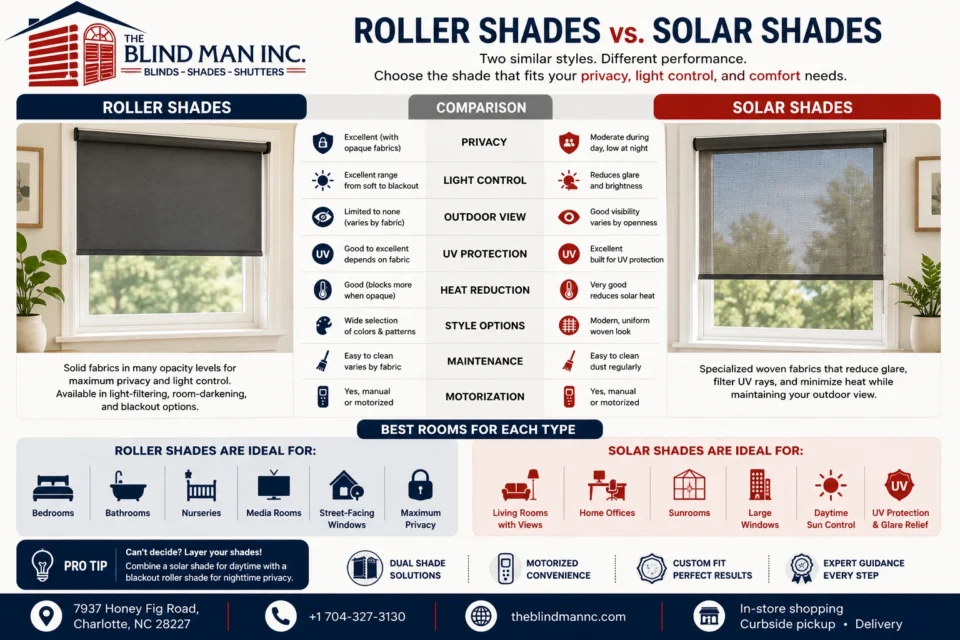
Roller shades are usually better for:
- Bedrooms
- Bathrooms
- Nurseries
- Street-facing windows
- Rooms used at night
- Ground-floor spaces requiring consistent privacy
Solar shades are often suitable for:
- Living rooms with private outdoor views
- Upper-floor windows
- Sunrooms
- Offices used mainly during the day
- Windows facing a backyard
- Large windows where preserving the view is important
How Do Roller and Solar Shades Compare for Light Control?
Roller shades offer more flexibility for controlling the overall amount of light entering a room. Solar shades are more specialized for managing glare and UV exposure.
Light-Filtering Roller Shades
Light-filtering roller shades soften incoming sunlight and reduce harsh brightness. They can create a comfortable glow without making the room feel dark.
These shades are often appropriate for:
- Living rooms
- Dining rooms
- Kitchens
- Hallways
- Family rooms
The exact level of privacy and brightness depends on the color, thickness, and weave of the fabric.
Room-Darkening Roller Shades
Room-darkening fabrics block more light than standard light-filtering materials. They may be suitable for bedrooms, television rooms, and spaces where homeowners want reduced brightness without requiring full blackout conditions.
Blackout Roller Shades
Blackout roller shades use opaque fabric to block almost all light passing through the material. They are commonly used in:
- Bedrooms
- Nurseries
- Media rooms
- Home theaters
- Rooms used by shift workers
Blackout fabric does not always eliminate every source of light. Small gaps may remain at the sides, top, or bottom of the shade. Side channels or specialized mounting methods may be needed when maximum darkness is the goal.
Solar Shade Light Control
Solar shades are designed to reduce the intensity of direct sunlight while preserving natural light and outdoor visibility.
They are particularly effective at reducing:
- Screen glare
- Harsh afternoon sunlight
- UV exposure
- Bright reflections
- Solar heat gain
Charlotte homes often receive strong sunlight, particularly through south- and west-facing windows. Solar shades can make bright rooms more comfortable without requiring homeowners to close off the outdoor view completely.
Fabric Color and Performance
The color of a solar shade can affect both visibility and heat management.
Darker solar fabrics generally provide clearer outdoor views and stronger glare control. Lighter fabrics may reflect more sunlight and coordinate better with bright interiors, but the outdoor view may appear less distinct.
The openness factor is also important. A one-percent openness fabric provides stronger sun control than a ten-percent openness fabric, but it also reduces the clarity of the view.
Energy Efficiency
Both shade types may contribute to indoor comfort by reducing direct solar heat.
Solar shades are especially effective at reducing heat and glare before sunlight spreads throughout the room. However, because the woven fabric contains small openings, some heat and light still pass through.
Opaque roller shades can block more light and may reduce heat transfer when fully lowered. Insulating performance depends on the material, fit, window type, and whether air can circulate around the edges.
Neither option replaces energy-efficient windows, proper sealing, or home insulation, but the right shade can make rooms feel more comfortable and reduce the need for frequent thermostat adjustments.
Which Rooms Are Best for Each Type of Shade?
The best shade depends on how the room is used, when it is occupied, and how much privacy, glare reduction, and darkness are needed.
Living Rooms
Both styles can work well in living rooms.
Solar shades are a strong choice when the room has large windows, a pleasant view, and significant daytime sunlight. They reduce glare and UV exposure while keeping the room visually connected to the outdoors.
Roller shades may be better when the living room faces a busy street or neighboring property. A light-filtering roller shade can soften sunlight while providing greater privacy.
Some homeowners combine solar shades with decorative curtains for a layered appearance and improved nighttime privacy.
Bedrooms
Roller shades are usually the better option for bedrooms.
Room-darkening or blackout fabrics can reduce early morning light, improve privacy, and create a more comfortable sleeping environment. Solar shades typically do not provide enough nighttime privacy or darkness for most bedrooms.
A motorized roller shade can be programmed to close in the evening and open gradually in the morning.
Home Offices
Solar shades are often ideal for home offices because they reduce screen glare without eliminating natural light.
They can help homeowners see computer monitors more comfortably while maintaining a view outside. This may make the workspace feel brighter and less enclosed.
A tighter openness factor may be needed for windows that receive intense afternoon sun. If the office is used for confidential meetings or faces a public area, an opaque roller shade may provide better privacy.
Media Rooms
Blackout roller shades are typically better for media rooms and home theaters.
Solar shades reduce glare but do not usually block enough light for a dark viewing environment. Blackout roller shades can minimize reflections on television and projector screens.
For maximum darkness, homeowners may need side channels or overlapping window treatments to address light entering around the edges.
Sunrooms
Solar shades are well suited to sunrooms.
They help manage the room’s strongest challenges, including heat, glare, and UV exposure, while allowing homeowners to enjoy the surrounding view. Solar shades can also help protect rugs, furniture, and flooring from fading.
Different openness factors may be used depending on the direction each window faces.
Kitchens
Either style may be appropriate for kitchens.
Solar shades can reduce heat and glare around large windows or breakfast areas. Roller shades provide more privacy and decorative flexibility.
Homeowners should select fabrics that are easy to maintain and suitable for areas where cooking residue and moisture may accumulate.
Bathrooms
Roller shades are generally the better choice for bathrooms because they can provide full privacy.
The selected fabric should be suitable for humid conditions. Solar shades may not provide enough nighttime privacy, particularly when bathroom lights are on.
Dining Rooms
Light-filtering roller shades can create a soft, comfortable atmosphere in dining rooms. Solar shades may work better when the dining area has large windows and a view that homeowners want to preserve.
The best choice depends on whether privacy or sun protection is the greater concern.
How Do Roller Shades and Solar Shades Compare in Cost?
The cost of either shade depends on the window size, fabric, control system, hardware, customization, and installation requirements.
Neither category is always more expensive than the other. A basic manual roller shade may cost less than a premium solar shade, while a designer roller fabric with motorization may cost considerably more.
Factors Affecting Roller Shade Cost
Roller shade pricing may vary based on:
- Fabric type
- Blackout or light-filtering construction
- Decorative patterns and textures
- Custom sizing
- Cassette or fascia options
- Cordless controls
- Motorization
- Smart-home integration
- Side channels
- Professional installation
Blackout materials and specialty fabrics often cost more than basic light-filtering options.
Factors Affecting Solar Shade Cost
Solar shade pricing may depend on:
- Openness factor
- Fabric quality
- Window dimensions
- Exterior or interior installation
- Manual or motorized operation
- Hardware finish
- Custom brackets
- Smart controls
- Professional installation
Large windows may require stronger roller tubes and upgraded hardware to support the weight of the fabric.
Motorization Costs
Motorization increases the initial cost of both roller and solar shades. The final price can vary depending on whether the system uses batteries, rechargeable motors, low-voltage wiring, remote controls, wall switches, or smart-home integration.
Motorization may be worth considering for:
- Hard-to-reach windows
- Tall stairwell windows
- Large shade panels
- Homes with many windows
- Homeowners with mobility limitations
- Automated glare and heat management
Long-Term Value
Price should be evaluated alongside performance and room usage.
An inexpensive shade that does not provide enough privacy or glare reduction may need to be replaced sooner. A properly selected shade can remain useful for years and may help protect furnishings, improve comfort, and simplify daily light control.
Homeowners should compare fabric quality, warranty coverage, hardware durability, and installation accuracy rather than selecting a product based only on the lowest initial price.
How The Blind Man Can Help
Choosing between roller shades and solar shades requires more than comparing fabric samples. Window direction, room use, privacy expectations, glare, heat, décor, and operating preferences can all affect which option performs best.
The Blind Man can evaluate existing windows and help homeowners understand how different materials will function in their specific spaces. A professional consultation may include reviewing sunlight patterns, comparing openness factors, discussing blackout requirements, measuring unusual windows, and evaluating manual or motorized operation.
Homeowners can also explore available Shades designed for different levels of privacy, light filtering, room darkening, glare reduction, and UV protection.
The goal is not to declare one shade universally better. Roller shades and solar shades solve different problems. A professional assessment helps homeowners choose the right treatment for each room and avoid selecting a fabric that looks attractive but does not meet the practical needs of the space.
FAQs
Are solar shades the same as roller shades?
Solar shades use the same basic rolling mechanism as roller shades, but they are made from specialized woven fabric designed to reduce glare, filter UV rays, and maintain outdoor visibility. Traditional roller shades offer a broader range of privacy and opacity options.
Can people see through solar shades at night?
Yes. When interior lights are on and it is dark outside, people may be able to see through solar shades into the home. They should be paired with another treatment when nighttime privacy is important.
Do solar shades block heat?
Solar shades can reduce solar heat gain by filtering direct sunlight before it spreads throughout the room. Their performance depends on fabric color, openness factor, window direction, and installation.
Are roller shades good for bedrooms?
Yes. Room-darkening and blackout roller shades are popular for bedrooms because they provide privacy and reduce incoming light.
Do solar shades make a room dark?
Solar shades reduce glare and brightness, but they generally allow natural light to enter. A lower openness factor creates a darker room than a higher openness factor.
Which shade is easier to clean?
Both shade types are relatively easy to maintain. Roller shades can usually be dusted or lightly vacuumed, although cleaning instructions vary by fabric. Solar shades should be cleaned gently to avoid distorting the specialized weave.
Can roller and solar shades be motorized?
Yes. Both styles are available with motorized controls. Depending on the system, they may be operated using a remote, wall switch, smartphone, or smart-home platform.
Which shade offers better UV protection?
Solar shades are specifically engineered to filter UV rays and are often the better option for protecting furniture, floors, and artwork while maintaining an outdoor view. Opaque roller shades can block substantial UV exposure when fully lowered.
Can I use solar shades in a bedroom?
Solar shades can be used in a bedroom, but they may not provide enough darkness or nighttime privacy on their own. Pairing them with blackout curtains or a second shade may improve performance.
What openness factor should I choose for solar shades?
A lower openness percentage provides stronger glare reduction, UV protection, and privacy but reduces the outdoor view. A higher percentage preserves more visibility and natural light but allows more glare and visibility through the fabric.
Are roller shades more energy-efficient than solar shades?
Neither option is automatically more energy-efficient. Solar shades are designed to reduce direct solar heat, while opaque roller shades may block more sunlight. Performance depends on the fabric, fit, window type, and installation.
Which shade is best for large windows?
Solar shades are often selected for large windows because they reduce glare while preserving the view. Roller shades may also work well, particularly when privacy or room darkening is the priority. Large windows may require reinforced hardware or motorization.
Share this article
Latest articles

October 8, 2026
October 8, 2026

October 8, 2026