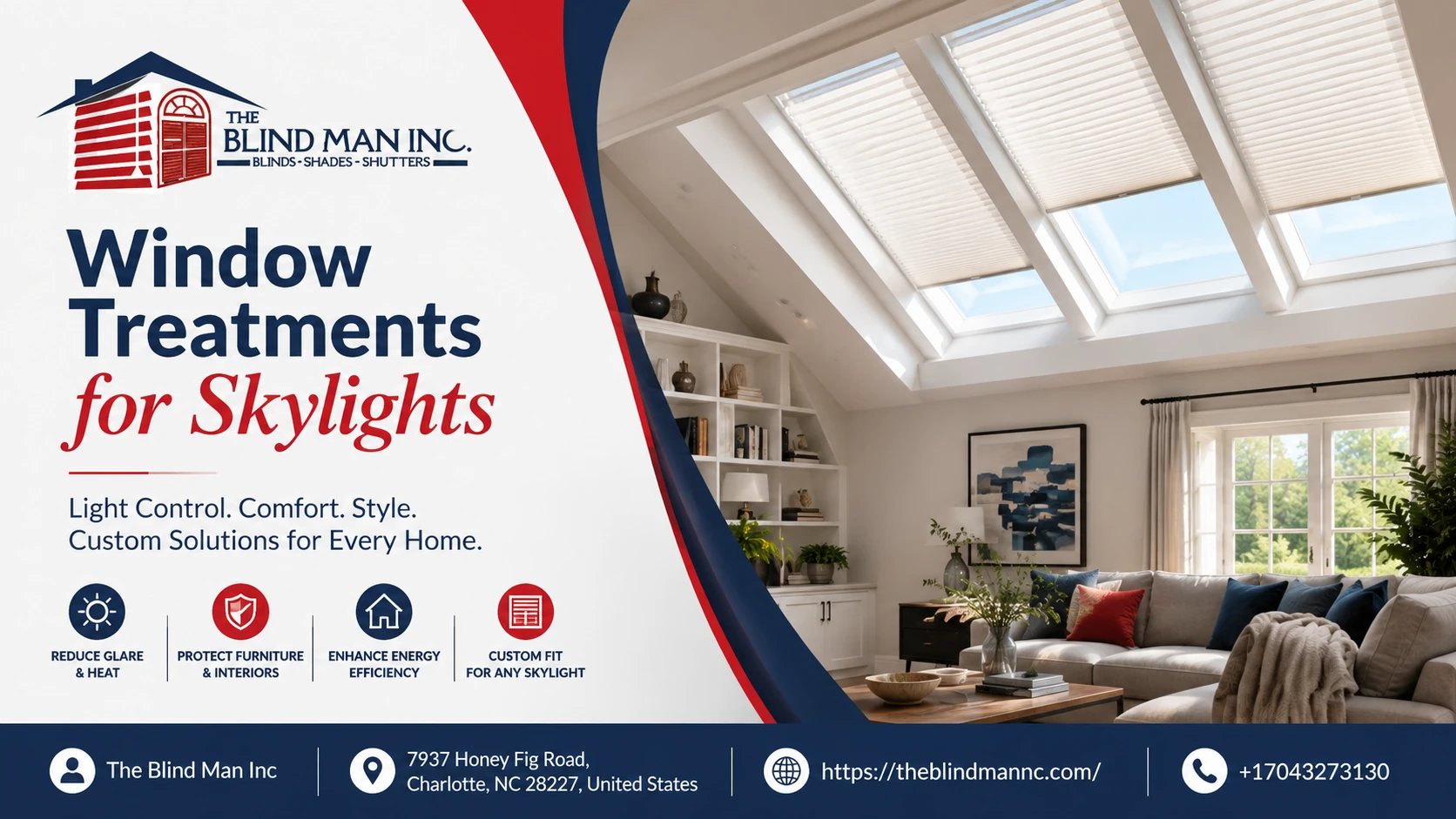
The best skylight window treatments are designed specifically for angled or overhead windows. Cellular skylight shades, light-filtering shades, room-darkening shades, and blackout shades can reduce heat, glare, UV exposure, and nighttime heat loss while preserving the benefits of natural light.
Skylights can make a room feel brighter, larger, and more connected to the outdoors. However, they also create challenges that standard blinds and shades are not designed to solve. Because skylights are often installed overhead or at an angle, their coverings must remain securely in place instead of hanging away from the glass.
The right shade can make a noticeable difference in rooms that become too bright, warm, or uncomfortable during the day. Motorized options are often the most practical choice because they allow homeowners to adjust hard-to-reach skylights without using ladders or extension poles.
What Makes Skylights Challenging to Cover?
Skylights differ from ordinary windows in their position, angle, and exposure to direct sunlight. These differences affect which window treatments can be used and how they must be installed.
Skylights Receive Intense Sunlight
Because skylights face upward, they may receive direct sunlight for extended periods. This can introduce more heat and brightness than a similarly sized vertical window.
In Charlotte’s sunny climate, uncovered skylights can contribute to:
- Uncomfortable room temperatures
- Strong glare
- Increased cooling demand
- Fading of furniture and flooring
- Uneven indoor temperatures
- Difficulty viewing televisions and computer screens
The amount of heat and glare depends on the skylight’s direction, roof slope, glass type, size, and surrounding shade.
Heat Gain Can Make Rooms Uncomfortable
Sunlight passing through overhead glass can quickly warm a room. This is especially noticeable in upper-level bedrooms, lofts, kitchens, sunrooms, and home offices.
The heat may collect near the ceiling before spreading throughout the room. Homeowners may respond by lowering the thermostat or running fans more frequently, even when the rest of the home feels comfortable.
A fitted skylight shade can reduce direct solar heat before it enters the living space.
Skylights Can Lose Heat at Night
Skylights may also contribute to nighttime heat loss, particularly during cooler weather. Warm indoor air rises toward the ceiling, placing it close to the skylight glass.
An insulating shade can create an additional barrier between the room and the window. Although a shade cannot correct poor glazing or air leaks, it may improve comfort and reduce the feeling of cold radiating from the glass.
Glare Can Interfere With Room Use
Bright overhead sunlight can create glare in places where vertical window coverings offer little protection.
Glare may affect:
- Television viewing
- Computer work
- Reading
- Dining
- Cooking
- Resting
- Artwork displays
A light-filtering shade may soften the light, while room-darkening or blackout fabric can provide stronger control.
UV Rays Can Fade Interior Materials
Skylights may expose flooring, rugs, furniture, artwork, and upholstery to concentrated sunlight. Over time, UV rays can cause colors to fade and certain materials to become brittle.
The damage may appear uneven because the sun moves across the room during the day. A skylight shade with UV-filtering material can help protect the items below.
Standard Shades May Sag or Hang Incorrectly
A regular roller shade or blind is designed to hang vertically. When installed on a sloped or overhead surface, gravity can pull it away from the glass.
This can result in:
- Sagging fabric
- Uneven gaps
- Poor light control
- Difficult operation
- Strain on the hardware
- Premature product failure
Skylight shades use guide tracks, tension systems, side channels, or specialized frames to keep the material close to the window.
Skylights Are Often Difficult to Reach
Many skylights are installed above staircases, vaulted ceilings, kitchens, or tall living areas. Manual operation may require a long extension pole or ladder.
Hard-to-reach treatments are less likely to be adjusted regularly. This can reduce their usefulness for heat, glare, and privacy control.
Motorization solves this problem by allowing homeowners to operate the shade from floor level.
What Are the Best Window Treatments for Skylights?
The best treatment depends on the room, the desired level of darkness, insulation needs, and how much natural light the homeowner wants to preserve.
Light-Filtering Skylight Shades
Light-filtering shades soften harsh sunlight without making the room completely dark. They are a practical option for spaces where homeowners want natural light but need relief from glare and brightness.
These shades can help create a more even, comfortable glow throughout the room.
Light-filtering skylight shades are often suitable for:
- Kitchens
- Dining rooms
- Living rooms
- Hallways
- Sunrooms
- Home offices
Benefits of Light-Filtering Shades
- Soften direct sunlight
- Reduce glare
- Filter some UV rays
- Maintain a bright atmosphere
- Provide a clean appearance
- Improve daytime comfort
Tradeoffs
- Do not provide complete darkness
- May offer limited privacy
- Allow some heat to pass through
- Performance varies by fabric
Light-filtering fabric works well when the goal is to reduce intensity rather than block daylight.
Room-Darkening Skylight Shades
Room-darkening shades block more light than light-filtering fabrics but may not create complete blackout conditions.
They are useful when homeowners want stronger brightness control while still allowing a small amount of ambient light around the shade.
Room-darkening skylight shades may be appropriate for:
- Bedrooms
- Nurseries
- Media rooms
- Home offices
- Guest rooms
- Loft spaces
Benefits of Room-Darkening Shades
- Reduce strong daylight
- Improve screen visibility
- Increase privacy
- Help control heat
- Create a more restful atmosphere
Tradeoffs
- Do not always block all light
- Small gaps may remain around the frame
- Reduce the amount of natural light available
- May require side channels for improved coverage
Room-darkening shades offer a middle ground between soft light filtering and complete blackout.
Blackout Skylight Shades
Blackout shades are designed for rooms where maximum light control is important. Their opaque fabric blocks nearly all light passing through the material.
They are commonly used in:
- Bedrooms
- Nurseries
- Home theaters
- Media rooms
- Rooms used by shift workers
- Spaces where light-sensitive occupants sleep
Blackout performance depends on both the fabric and the installation. Even opaque material may allow light around the edges if the shade is not fitted properly.
Benefits of Blackout Shades
- Provide strong darkness
- Reduce glare significantly
- Improve sleeping conditions
- Increase privacy
- Help reduce solar heat
- Protect furnishings from direct sunlight
Tradeoffs
- Remove most natural light when closed
- May make small rooms feel darker
- Require precise fitting
- Can cost more than basic light-filtering shades
Side channels or enclosed frames may be needed when near-total darkness is the goal.
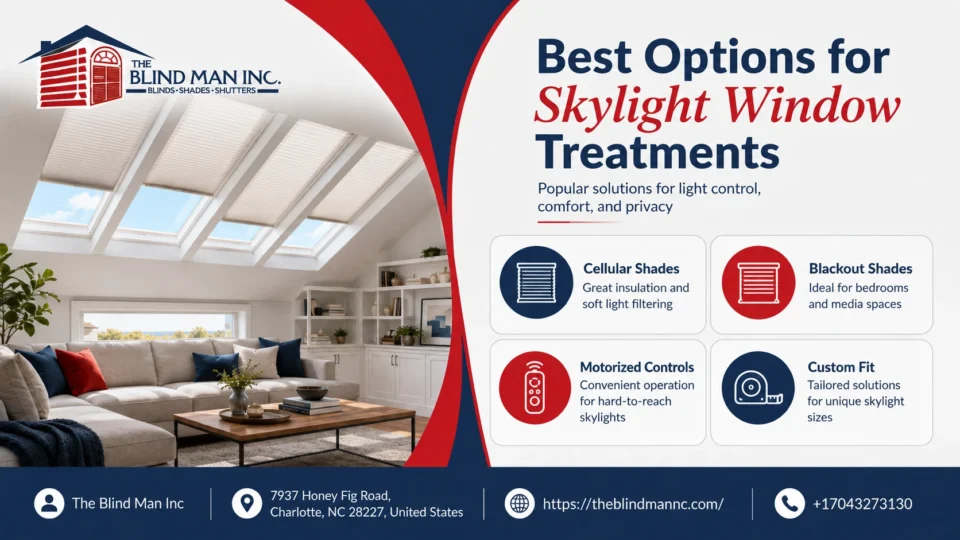
Cellular Skylight Shades
Cellular shades are one of the most practical choices for skylights because their honeycomb-shaped pockets trap air near the glass.
This construction can improve insulation and help reduce both summer heat gain and winter heat loss.
Cellular skylight shades may be available in:
- Light-filtering fabrics
- Room-darkening fabrics
- Blackout fabrics
- Single-cell designs
- Double-cell designs
Benefits of Cellular Skylight Shades
- Provide additional insulation
- Help control indoor temperatures
- Reduce glare and UV exposure
- Offer multiple opacity levels
- Fit neatly within skylight frames
- Work well with motorization
- Support year-round comfort
Tradeoffs
- Block the view when closed
- Fabric cells may collect dust
- Precise installation is important
- Moisture and condensation should be managed
- Premium models may cost more
Cellular shades are especially useful in rooms where temperature control is the main concern.
Roller-Style Skylight Shades
Roller-style shades can also be designed specifically for skylights. Unlike standard roller shades, these products use tension systems or side tracks to keep the fabric close to the glass.
They are available in light-filtering, solar, room-darkening, and blackout materials.
Benefits of Roller-Style Skylight Shades
- Clean, minimal appearance
- Broad fabric selection
- Multiple light-control options
- Easy integration with motorization
- Suitable for modern interiors
- Compact when opened
Tradeoffs
- Insulation varies by fabric
- Side gaps may affect light control
- Large skylights may need stronger hardware
- Standard roller shades cannot simply be adapted for overhead use
Homeowners should confirm that the product is designed and rated specifically for skylight installation.
Solar Skylight Shades
Solar fabrics can reduce glare, filter UV rays, and limit solar heat while still allowing some light through the material.
They may be useful in rooms where homeowners want sun control without full darkness.
However, preserving an outdoor view is usually less important with skylights than with vertical windows. The primary benefits are glare reduction and UV protection.
Benefits of Solar Skylight Shades
- Reduce harsh brightness
- Filter UV rays
- Help control heat
- Maintain some natural light
- Work well in bright living spaces
Tradeoffs
- Do not provide blackout performance
- Offer limited privacy
- Allow some heat through the weave
- May not provide as much insulation as cellular shades
Solar fabrics are most useful when glare and UV exposure are the main concerns.
What Should You Know About Skylight Shade Installation?
Skylight shade installation requires more precision than installing a standard blind on a vertical window. The shade must remain secure against gravity and operate smoothly across the entire opening.
Accurate Measurements Are Essential
Small measuring errors can create gaps, cause the shade to bind, or prevent the side tracks from aligning correctly.
Professional measurement typically accounts for:
- Width at several points
- Height at several points
- Window depth
- Frame shape
- Roof slope
- Mounting surface
- Handle or vent locations
- Available space for tracks
- Motor and power requirements
Skylight openings are not always perfectly square, even in newer homes. Custom measurements help account for small variations.
The Window Slope Affects the System
A slightly angled roof window may require a different support system than a nearly horizontal skylight.
The greater the angle, the more important it becomes to use tracks, cables, or tension mechanisms that prevent sagging.
The selected treatment should be designed for the skylight’s actual slope rather than chosen only by size.
Fixed and Venting Skylights Need Different Considerations
Some skylights are fixed, while others open for ventilation.
A shade installed over a venting skylight must not interfere with:
- Handles
- Cranks
- Motors
- Hinges
- Insect screens
- Rain sensors
- Opening mechanisms
The shade and skylight should be able to operate independently without damaging each other.
Proper Mounting Protects the Shade
A secure mounting surface is necessary because the shade will operate overhead. Loose brackets or poorly anchored tracks can lead to uneven movement or hardware failure.
Professional installers can determine whether mounting should occur inside the skylight well, on the frame, or around the surrounding opening.
Power Planning Should Happen Before Installation
Motorized skylight shades may use batteries, low-voltage wiring, standard electrical connections, or solar charging.
The power source should be selected before the shade is ordered because it may affect:
- Motor type
- Bracket placement
- Wiring access
- Control options
- Maintenance
- Installation cost
Hardwired systems may require coordination with an electrician, especially in new construction or major remodeling projects.
Custom Products Usually Perform Better
Ready-made products may not match the exact size or angle of the skylight. Gaps and poor tension can reduce light control, insulation, and reliability.
A custom-fitted shade is more likely to:
- Stay aligned
- Cover the full opening
- Operate smoothly
- Minimize edge gaps
- Support the fabric correctly
- Work with the skylight’s venting features
Professional installation also reduces the need for homeowners to work on ladders near overhead glass.
Why Should You Consider Motorized Skylight Shades?
Motorized shades are often the most practical solution for skylights because they make daily operation simple and safe.
A shade that is difficult to reach may remain open even when it is causing heat or glare. Motorization allows homeowners to use the treatment consistently.
Easier Daily Operation
Motorized skylight shades can be controlled using:
- Handheld remotes
- Wall switches
- Smartphone applications
- Smart-home systems
- Voice controls
- Automatic schedules
This eliminates the need for long extension poles or repeated ladder use.
Better Control of Heat and Glare
Homeowners can close the shade before the room becomes excessively warm. This is often more effective than waiting until heat has already accumulated.
In Charlotte, automated shades can be scheduled to close during the brightest afternoon hours and reopen when direct sunlight has passed.
This may improve comfort and reduce the need for frequent thermostat adjustments.
Scheduled Operation
Motorized shades can follow daily routines.
Possible schedules include:
- Opening in the morning
- Closing before peak sunlight
- Reopening in the late afternoon
- Closing at sunset
- Adjusting seasonally
- Closing while the home is unoccupied
Scheduled operation helps ensure the shades are used even when homeowners are busy or away.
Smart-Home Integration
Some motorized systems can connect with compatible smart-home platforms.
They may coordinate with:
- Thermostats
- Lighting systems
- Sunrise and sunset schedules
- Temperature sensors
- Voice assistants
- Home security routines
For example, a skylight shade may close automatically when the room reaches a certain temperature or when the cooling system begins working harder.
Compatibility varies by manufacturer, so homeowners should confirm which platforms and controls are supported.
Improved Accessibility
Motorization can make skylight shades easier to use for homeowners with:
- Limited mobility
- Arthritis
- Shoulder or back problems
- Balance concerns
- High ceilings
- Multiple skylights
A wall switch or remote allows the shade to be adjusted without physical strain.
Safer Than Ladders or Extension Poles
Regularly using a ladder to operate an overhead shade creates an unnecessary fall risk. Extension poles may also be awkward and can damage the fabric or operating mechanism if used incorrectly.
Motorized controls allow the shade to remain accessible from floor level.
Battery-Powered Motors
Battery-powered motors are useful when running electrical wiring is impractical.
Depending on the system, the batteries may be replaceable or rechargeable.
Advantages include:
- Minimal wiring
- Easier installation
- Suitability for finished rooms
- Flexible placement
Homeowners should consider how easily the batteries can be accessed. A battery system installed several meters above the floor may still require occasional ladder use for charging or replacement.
Hardwired Motors
Hardwired systems connect to the home’s electrical supply.
They are often selected for:
- New construction
- Major renovations
- Large shades
- Frequently operated treatments
- Multiple connected skylights
- Home automation systems
Hardwired motors avoid routine battery replacement but may require electrical planning and a higher installation cost.
Solar-Powered Motors
Some skylight shades use small solar panels to charge the motor battery.
Solar-powered options can be practical because skylights receive abundant sunlight. They may reduce the need for wiring and manual battery charging.
Performance depends on:
- Skylight orientation
- Available sunlight
- Panel placement
- Battery capacity
- Frequency of operation
- Manufacturer specifications
The solar panel and battery should be sized for the system’s expected use.
Group Control
Homeowners with several skylights can often operate them together.
Group controls allow multiple shades to open or close simultaneously. This is convenient in large living rooms, sunrooms, lofts, and open-concept spaces.
Individual controls may still be used when one part of the room receives more sunlight than another.
Motorization Costs
Motorized skylight shades generally cost more than manual shades because they include motors, controls, and additional installation requirements.
Pricing can vary based on:
- Window size
- Shade material
- Motor strength
- Power source
- Remote or wall controls
- Smart-home integration
- Number of skylights
- Installation difficulty
The added cost may provide greater value when the skylight is very high, frequently adjusted, or responsible for significant heat and glare.
How The Blind Man Can Help
Choosing a skylight shade requires careful attention to the window’s size, slope, location, and operating system. The right product should fit securely, move smoothly, and provide the appropriate balance of light control, insulation, and convenience.
The Blind Man can help homeowners compare light-filtering, room-darkening, blackout, cellular, solar, and motorized skylight shades. A professional consultation can also identify installation challenges that may not be obvious from the floor.
An evaluation may include:
- Measuring the skylight opening
- Confirming the window angle
- Checking whether the skylight opens
- Reviewing heat and glare problems
- Comparing fabric opacity
- Discussing insulation needs
- Evaluating battery, hardwired, and solar power
- Reviewing remote and smart-home controls
- Planning access for future maintenance
Homeowners can also explore available Shades designed for different levels of light filtering, UV protection, privacy, and energy efficiency.
The purpose of professional guidance is to help homeowners avoid poorly fitted products and inconvenient operating systems. A custom shade that matches the skylight and the room’s daily needs is more likely to provide dependable performance over the long term.
FAQs
Do skylights need special window treatments?
Yes. Skylights usually require shades designed for angled or overhead installation. Standard window treatments may sag, hang away from the glass, or operate unreliably.
What is the best shade for reducing skylight heat?
Cellular skylight shades are often effective because their honeycomb construction provides additional insulation. Solar and blackout shades can also reduce heat by limiting direct sunlight.
Can blackout shades completely darken a skylight?
Blackout fabric blocks nearly all light passing through the material. However, complete darkness may require side channels or enclosed frames to reduce light around the edges.
Are motorized skylight shades worth the cost?
Motorized shades are often worthwhile for high, hard-to-reach, or frequently adjusted skylights. They improve convenience, accessibility, and consistent heat control.
How are motorized skylight shades powered?
They may use replaceable batteries, rechargeable batteries, hardwired electricity, low-voltage wiring, or solar charging. The best option depends on accessibility, frequency of use, and the room’s construction.
Can skylight shades connect to a smart-home system?
Some motorized shades can connect with compatible smart-home platforms, allowing control through apps, schedules, sensors, or voice commands. Compatibility should be confirmed before ordering.
Do skylight shades help reduce energy costs?
They may reduce solar heat gain in summer and heat loss in cooler weather. Actual savings depend on the shade, glass, fit, insulation, climate, and how consistently the treatment is used.
What type of skylight shade is best for a bedroom?
Room-darkening or blackout cellular shades are often suitable for bedrooms because they reduce early morning light and provide additional insulation.
Are light-filtering shades suitable for kitchens?
Yes. Light-filtering skylight shades can soften glare while keeping the kitchen bright. Fabrics should be selected with heat, moisture, and cleaning requirements in mind.
Can a shade be installed on a venting skylight?
Yes, but the shade must be compatible with the skylight’s opening mechanism, handles, motors, and sensors. Professional measurement is especially important.
How long do motorized skylight shades last?
Their lifespan depends on fabric quality, motor construction, frequency of use, installation, and maintenance. Batteries may require periodic charging or replacement even when the shade itself remains in good condition.
Can solar-powered skylight shades operate on cloudy days?
Many systems store energy in a rechargeable battery, allowing the shade to operate when sunlight is limited. Performance depends on the system design and available charge.
Do skylight shades protect furniture from fading?
UV-filtering, solar, room-darkening, and blackout fabrics can reduce exposure that contributes to fading. The level of protection varies by material.
Can I measure a skylight for shades myself?
Homeowners can take preliminary measurements, but professional measurement is usually recommended. Skylight depth, slope, frame shape, and operating hardware can affect the required size and mounting system.
How should skylight shades be cleaned?
Most can be dusted gently with a microfiber cloth or vacuumed using a soft brush attachment. Cleaning instructions vary by fabric, so homeowners should follow the manufacturer’s recommendations.
When should a skylight shade be replaced?
Replacement may be necessary when the fabric is faded, sagging, torn, or stained, or when the shade no longer moves smoothly. Repeated motor problems, damaged tracks, and poor fit may also justify replacement.
Share this article
Latest articles
October 13, 2026
October 13, 2026
October 13, 2026