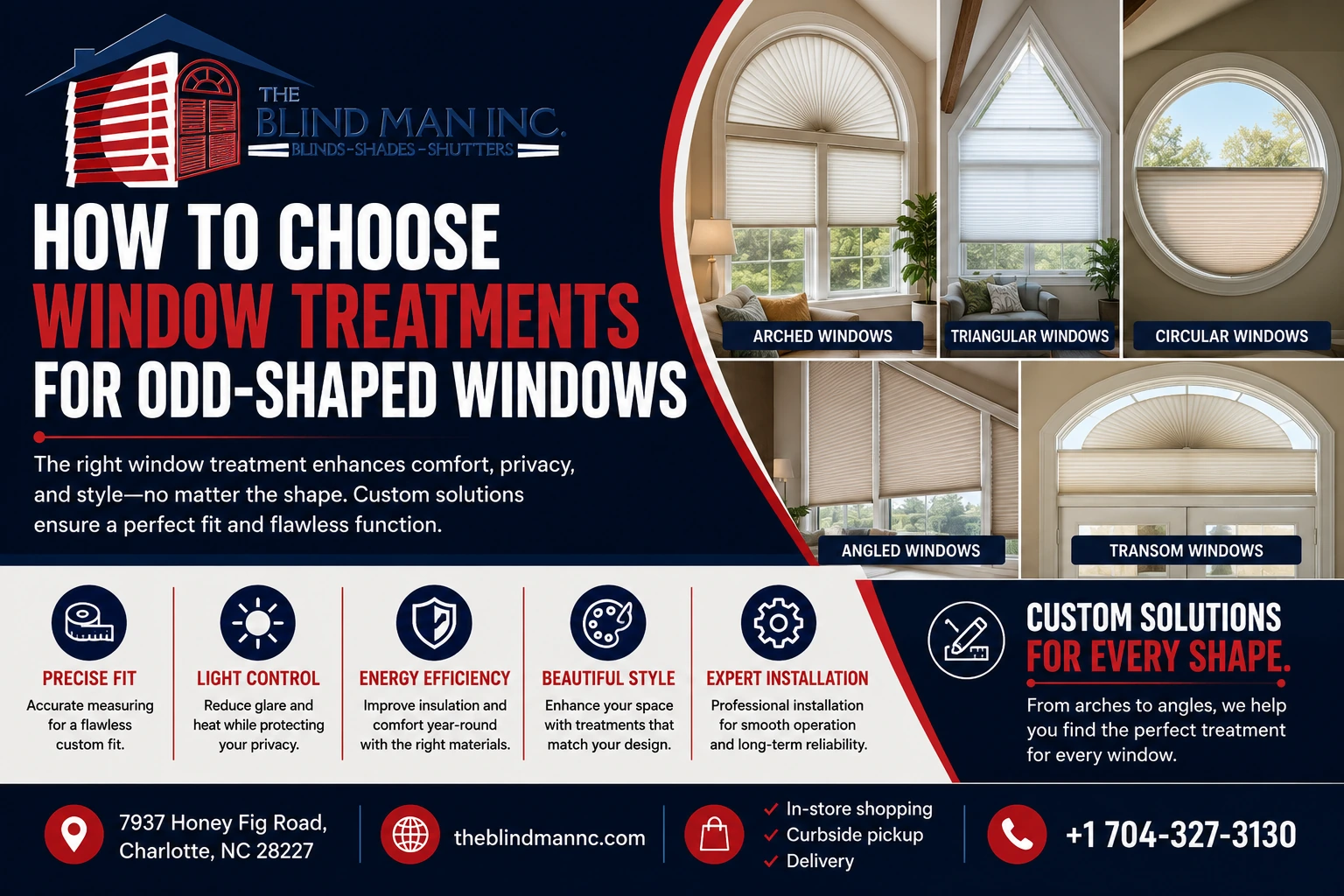
Choosing window treatments for odd-shaped windows requires accurate measurements, the right mounting method, and a product designed for the window’s exact form. Arches, angles, circles, triangles, and unusually tall openings often need custom solutions because standard blinds and shades rarely fit or operate correctly.
The best choice depends on whether you want full coverage, filtered light, privacy, insulation, or a decorative finish. Careful planning helps preserve the window’s architectural character while improving comfort and function. A professional assessment can prevent poor fit, uneven gaps, and unnecessary expense in every season.
Why Odd-Shaped Windows Need Custom Planning
Odd-shaped windows add character, natural light, and architectural interest to a room. They also create practical challenges that standard window treatments are not designed to solve.
A rectangular shade may leave open sections around an arch or triangle. A standard blind may not follow a sloped frame. Poorly fitted treatments can also block part of the glass, interfere with trim, or look disconnected from the window.
Shape Affects Function
The shape of the opening determines which treatments can move and which must remain fixed. Some arched shades are stationary, while others can open from the center or fan outward.
Angled windows may require special tracks, reinforced hardware, or fixed panels. Circular and oval windows often need treatments built specifically for the existing window frame.
Light Enters Differently
Unusual windows often sit high on walls, above doors, or near rooflines. Their position may bring in especially strong sunlight at certain times of day.
A treatment should reduce glare and heat without covering more glass than necessary. This is especially important when the window is a major design feature.
Privacy Needs Vary
A high transom may not need full privacy, while an angled bedroom window may require complete coverage. Planning should begin with how the room is used, not only how the window looks.
Best Options for Arched and Specialty Windows
The best treatment depends on the window’s geometry, location, and desired level of control.
Cellular Shades
Cellular shades are one of the most adaptable choices for specialty windows. They can be made for arches, circles, angles, skylights, and other unusual forms.
Their honeycomb structure adds insulation and helps reduce unwanted heat transfer indoors. Light-filtering fabrics soften daylight, while blackout materials provide stronger room darkening.
Some specialty cellular shades remain fixed. Others can open partially, depending on the shape and operating system.
Shutters
Custom shutters work well for arches, circles, triangles, and angled windows. Their solid frames follow the shape of the opening, creating a tailored appearance.
Adjustable louvers provide flexible light and privacy control. Shutters are also durable and easy to clean, making them useful in living rooms, bedrooms, bathrooms, and entryways.
Drapery
Drapery can cover unusual windows without following every curve or angle. A rod installed above or beyond the window allows panels to frame the entire opening.
This approach works well when full coverage is more important than displaying the shape. Drapery can also be layered with a custom shade for better insulation and privacy.
Solar and Roller Shades
Custom roller and solar shades can suit tall, narrow, or angled windows when the design allows a straight operating path.
Solar fabrics are useful for reducing glare and ultraviolet exposure while preserving some outdoor visibility. Roller shades offer a clean look and can be motorized for hard-to-reach openings.
Specialty Blinds
Measuring Challenges to Know
Measuring odd-shaped windows is more complex than recording width and height. Small errors can affect fit, appearance, and operation.
Multiple Dimensions Are Required
An arch may require the width, total height, straight-side height, and radius. A trapezoid may need the top width, bottom width, left height, right height, and angle.
Circular windows require an accurate diameter. Triangles may need each side and the exact relationship between corners.
Frames May Not Be Symmetrical
Older homes and custom construction often include openings that look balanced but are slightly uneven. One side may be taller, or the curve may not be perfectly centered.
Assuming symmetry can lead to gaps or a treatment that will not fit inside the frame.
Inside and Outside Mounts Differ
An inside mount fits within the window frame and preserves surrounding trim. It requires enough depth for brackets, hardware, and the treatment itself.
An outside mount attaches to the wall or trim. It can cover irregular edges and provide fuller light control, but it may hide part of the window’s architecture.
Obstacles Can Affect Installation
Handles, cranks, locks, deep trim, molding, and nearby walls can interfere with mounting. Furniture, staircases, and ceiling height may also limit access.
Style Choices for Unique Windows
Odd-shaped windows often serve as focal points. The treatment should support the architecture rather than make the opening look crowded.
Preserve the Shape
A custom treatment that follows the window’s exact outline highlights the original design. This approach works especially well with arches, circles, and triangles.
Shutters can also emphasize architectural lines while adding structure.
Create Visual Balance
A specialty window may sit beside standard rectangular windows.
Decide Whether to Feature or Conceal
Some homeowners want the unusual shape fully visible. Others prefer to simplify the wall by covering the entire opening with drapery or an outside-mounted treatment.
The right choice depends on the room’s style, the amount of glass, and the desired level of privacy.
Consider Color and Pattern Carefully
Bold patterns can become distorted on arched or angled treatments. Solid colors and subtle textures are often easier to fit visually.
If pattern is important, drapery may provide a better surface than a fitted specialty shade.
When Custom Treatments Are the Right Fit
Custom treatments are often the best choice when standard products cannot provide proper coverage, safe operation, or a clean appearance.
The Window Has an Unusual Geometry
Arches, trapezoids, triangles, circles, and steep angles usually require products made to exact dimensions. Ready-made options rarely match these shapes closely enough.
Light Gaps Are a Concern
Bedrooms, media rooms, and street-facing spaces may need stronger coverage. A custom product can reduce gaps and provide more reliable privacy.
The Window Is Large or Difficult to Reach
Tall windows and high specialty openings may require reinforced hardware, motorization, extension controls, or professional installation.
A custom system makes daily operation safer and more practical.

Design Consistency Matters
Custom products allow homeowners to coordinate specialty windows with treatments used elsewhere in the room. Fabrics, finishes, and operating styles can be matched across different shapes.
Benefits of Professional Measuring
Professional measuring reduces the risk of ordering an expensive treatment that does not fit or function correctly.
Better Accuracy
A trained specialist records the dimensions required for the exact product and mounting style. Measurements are taken at several points to identify uneven frames.
Product-Specific Knowledge
Different manufacturers use different measurement rules. A specialist understands required clearances, minimum depths, bracket placement, and operating limitations.
Fewer Installation Problems
Professional planning identifies obstacles before production begins. This can prevent conflicts with trim, handles, walls, ceilings, or nearby furnishings.
Clearer Expectations
Some specialty treatments cannot open fully. Others may have visible seams, fixed sections, or restricted movement.
A consultation helps homeowners understand these limitations before choosing a product.
More Reliable Results
Accurate measuring and proper installation improve light control, privacy, appearance, and long-term operation. They also protect the investment in a custom-made treatment.
Find the Perfect Fit for Every Window
The Blind Man helps homeowners choose window treatments for arches, angles, circles, triangles, tall windows, and other specialty openings. Each recommendation considers the window’s shape, room function, mounting space, light exposure, privacy needs, and design goals.
A professional consultation can clarify which products will operate correctly and which options are better suited as fixed treatments. Careful measuring and skilled installation help avoid gaps, awkward proportions, and costly ordering mistakes. With the right custom solution, even the most unusual window can become comfortable, functional, and visually complete.
Key Takeaways
Odd-shaped windows require careful planning because standard treatments rarely match their dimensions, angles, or operating needs. Cellular shades, shutters, drapery, roller shades, and specialty blinds can work when selected for the exact shape and room. Accurate measuring must account for uneven frames, mounting depth, hardware, and nearby obstacles. Custom treatments are especially valuable for unusual geometry, privacy, hard-to-reach openings, and coordinated design. Professional measuring improves fit, appearance, operation, and long-term value while helping homeowners avoid expensive mistakes before ordering, production, delivery, installation, or dependable daily operation at home successfully begins.
Share this article
Latest articles

October 13, 2026
October 13, 2026

October 13, 2026