

Window treatments do not need replacement on a fixed schedule. Quality blinds, shades, shutters, and drapes can last for many years, but their lifespan depends on material, construction, sun exposure, maintenance, and how frequently they are used.
Homeowners should consider replacing window treatments when mechanisms stop working reliably, materials become damaged, or privacy and light control no longer meet their needs.
An update may also make sense after remodeling or changing how a room is used. The important question is whether your existing coverings still look appropriate, operate safely, and perform their intended function.
How Often Should You Replace Window Treatments?
Is there a recommended replacement schedule?
There is no universal rule for how often to replace window treatments.
Some products remain functional for well over a decade, while others develop problems much sooner.
The difference depends on product quality, material durability, installation, environmental conditions, and daily operation.
For example, blinds in a frequently used kitchen may experience more handling, moisture, and cleaning than decorative shades in a guest bedroom.
A shade exposed to intense afternoon sunlight may also deteriorate faster than a similar product in a room receiving indirect light.
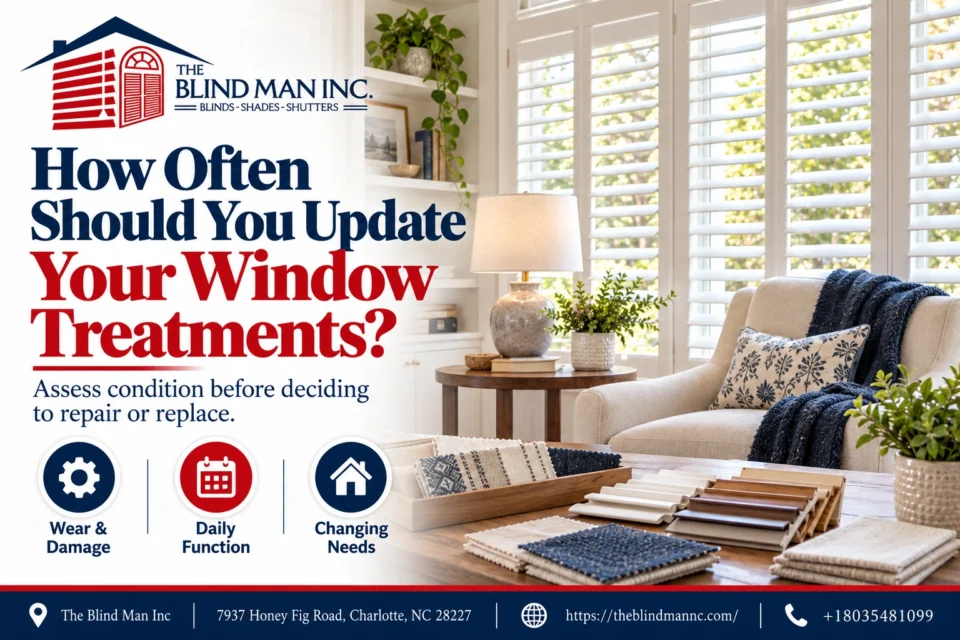
Instead of replacing treatments according to their age alone, evaluate their condition.
If they still operate smoothly, provide sufficient coverage, and complement the room, replacement may not be necessary.
When is repair better than replacement?
Minor problems do not always justify replacing an entire window covering.
Certain products allow damaged slats, brackets, operating components, or other parts to be repaired or replaced.
Repair may be practical when the treatment is otherwise in good condition and compatible replacement parts are available.
However, extensive fabric damage, repeated mechanical failures, or an outdated operating system may make replacement more reasonable.
Compare the cost, expected remaining lifespan, and safety of repairing the existing treatment against purchasing a new one.
How Long Do Quality Window Treatments Usually Last?
Do different window coverings have different lifespans?
Yes. Materials and construction methods affect how window treatments age.
However, published lifespan estimates vary widely, and no single number applies to every manufacturer or installation.
The following comparisons describe typical durability characteristics rather than guaranteed replacement intervals.
| Window treatment | Durability considerations | Common reasons for replacement |
| Aluminum blinds | Metal slats resist moisture but may bend | Bent slats, damaged mechanisms |
| Faux wood blinds | Generally resist moisture better than natural wood | Slat damage, mechanical wear |
| Real wood blinds | Can remain attractive with appropriate care | Warping, finish deterioration, broken components |
| Roller shades | Lifespan depends on fabric and operating system | Fading, fabric damage, roller problems |
| Cellular shades | Fabric cells provide insulation but require careful handling | Crushed cells, fabric damage, lift failure |
| Roman shades | Fabric condition and stitching influence longevity | Fading, stains, lining deterioration |
| Plantation shutters | Durable construction may support long service | Damaged louvers, finish wear, hardware problems |
| Drapes | Fabric quality and sunlight exposure are important | Fading, weakened fibers, outdated style |
These characteristics can help homeowners understand what to inspect.
They should not be interpreted as fixed product warranties.
Do expensive window treatments always last longer?
Not necessarily.
Higher-quality construction and components may improve durability, but price alone does not establish lifespan.
A well-made shade installed improperly may develop operating problems.
Likewise, an expensive fabric may fade when exposed to substantial sunlight without suitable protection.
Consider material quality, manufacturer support, available replacement parts, and installation rather than assuming that cost guarantees longevity.
What Causes Window Treatments to Wear Out Faster?
How does daily use affect durability?
Frequently operated window treatments experience repeated mechanical stress.
Lift systems, tilt mechanisms, cords, tracks, and moving components can gradually wear with use.
For example, blinds raised and lowered several times daily may experience more wear than treatments adjusted occasionally.
Uneven pulling, forcing stuck components, or operating a shade outside its intended range can also cause damage.
Following manufacturer instructions helps reduce unnecessary stress.
Can sunlight damage blinds and shades?
Yes. Prolonged sunlight exposure can contribute to fading, discoloration, and deterioration of certain materials.
Fabric shades and drapes may lose color or become more fragile over time.
Some plastics can become brittle after repeated exposure to heat and ultraviolet radiation.
Wood finishes may also change in appearance.
Windows receiving strong afternoon sunlight can experience greater exposure than windows shaded by trees or nearby buildings.
In Charlotte homes, west-facing windows deserve particular attention because they may receive substantial afternoon sun.
Does humidity shorten the lifespan?
Moisture and humidity can affect certain window covering materials.
Natural wood may expand, contract, or warp when exposed to unsuitable moisture conditions.
Some fabrics can develop stains or odor when moisture remains trapped.
Kitchens, bathrooms, and laundry areas may therefore require materials selected for their environment.
Faux wood, aluminum, and other suitable moisture-resistant materials may be easier to maintain in these locations.
What Signs Mean It May Be Time to Upgrade?
What mechanical problems indicate replacement?
Window treatments should operate without excessive force or repeated adjustment.
Common warning signs include:
- Blinds that no longer raise or lower evenly.
- Slats that will not tilt correctly.
- Roller shades that repeatedly become stuck.
- Broken brackets or unstable mounting hardware.
- Cellular shades that bunch unevenly.
- Operating mechanisms that fail despite appropriate maintenance.
These problems can affect convenience, light control, and sometimes safety.
An occasional adjustment may resolve a minor issue.
However, persistent failures suggest that repair or replacement should be considered.
When does physical damage become significant?
Cracked slats, torn fabric, bent rails, and broken louvers can affect appearance and performance.
A small damaged component may be repairable.
Widespread damage can make replacement more practical, especially when matching parts are unavailable.
Inspect the treatment’s overall condition rather than focusing on one defect.
If multiple components are deteriorating, another repair may provide only a temporary solution.
Are older window covering cords a safety concern?
Yes. Accessible cords on older window coverings can present serious strangulation hazards to young children.
The Window Covering Safety Council recommends replacing older corded window coverings with safer cordless products in homes with infants and young children.
A treatment may still operate perfectly but require replacement because its cord design creates a hazard.
Safety should take priority over appearance or remaining mechanical lifespan.
When Should Faded or Discolored Treatments Be Replaced?
Is fading always a reason to replace shades?
No. Mild fading does not necessarily affect a window covering’s function.
If the material remains intact and provides suitable privacy and light control, replacement may be optional.
However, substantial discoloration can make the room appear uneven or poorly maintained.
This becomes especially noticeable when adjacent windows have different levels of fading.
Homeowners may choose replacement when the visual difference no longer fits their expectations.
Can faded window treatments be restored?
Restoration depends on the material.
Some hard-surface blinds may benefit from appropriate cleaning.
Certain fabric treatments can be professionally cleaned, although cleaning will not reverse color loss caused by sunlight.
Repainting or refinishing may be possible for selected shutters or wood products.
Before attempting restoration, check manufacturer instructions.
Using unsuitable cleaners or treatments can damage finishes, fabrics, and operating components.
What if only one window treatment has faded?
Consider whether the affected window covering can be replaced with a matching product.
A matching replacement may be difficult when the original fabric or color has been discontinued.
In connected rooms, replacing only one treatment may create an obvious contrast.
Homeowners should compare the cost and visual outcome of individual replacement with updating an entire group of nearby windows.
Should You Replace Window Treatments That Still Work?
Is it worth upgrading functional blinds?
Sometimes.
A window treatment can operate correctly but no longer meet the household’s practical needs.
For example, blinds that provided adequate privacy when a home was purchased may feel insufficient after nearby construction changes outdoor visibility.
A room converted into a nursery may require safer cordless coverings and improved light control.
Likewise, a home office may need better glare management than the original coverings provide.
Replacing a functional treatment can be reasonable when the upgrade solves a specific problem.
When is keeping the existing treatment better?
Keep your current window coverings when they remain safe, functional, and appropriate for the room.
Minor cosmetic imperfections alone do not always justify replacement.
Cleaning, maintenance, or small repairs may restore acceptable appearance and operation.
Avoid replacing otherwise suitable products simply because they have reached an arbitrary age.
A practical decision considers function, condition, style, and replacement cost together.
How Do Changes in Privacy or Light Control Affect the Decision?
What if your current treatments no longer provide enough privacy?
Privacy requirements can change over time.
New neighboring buildings, changes in landscaping, or a different room arrangement can affect visibility through windows.
Sheer or solar materials that provide acceptable daytime privacy may not provide sufficient nighttime coverage.
Upgrading to more opaque shades, lined drapes, or layered coverings may address the problem.
The appropriate choice depends on window exposure and how the room is used.
When should you upgrade for better light control?
Excessive sunlight can cause glare, uncomfortable brightness, and unwanted heat gain.
If existing treatments cannot manage these conditions, changing the material may be more useful than repairing the current covering.
Solar shades can help reduce glare while maintaining some outdoor visibility.
Light-filtering shades soften daylight, while room-darkening options provide stronger control.
Blackout materials may be appropriate for bedrooms where greater darkness is preferred.
Homeowners can explore these different options through our Window Treatments page.
When Do New Interior Styles Justify an Update?
Should window treatments change during a renovation?
A renovation is a practical time to reassess window coverings.
New wall colors, flooring, furniture, and lighting may change how existing blinds or shades look within the room.
For example, heavy patterned drapes may no longer complement a renovated space with simple contemporary finishes.
Replacing them with understated shades could create a more consistent appearance.
However, updated window treatments should also support the room’s function.
The goal is not simply to follow current design trends.
Can you update one room without changing the entire house?
Yes.
Window treatments do not need to match throughout the home.
Bedrooms, bathrooms, kitchens, and living rooms have different requirements.
A homeowner may update a living room after remodeling while keeping functional bedroom treatments.
For connected spaces, consider coordinating colors, materials, or hardware so the design remains cohesive.
What styles tend to remain versatile?
Neutral roller shades, simple Roman shades, wood or faux wood blinds, and appropriately designed shutters can work with many interior styles.
Their suitability depends on the home’s architecture and existing finishes.
Choosing understated materials and colors may help reduce the desire for frequent cosmetic replacement.
However, long-term satisfaction is more important than selecting a product solely because it appears timeless.
Can New Window Treatments Improve Energy Efficiency?
Do older blinds provide less insulation?
Not necessarily because of age alone.
Insulating performance depends primarily on design, material, fit, and operating condition.
Standard slatted blinds generally provide less insulation than well-fitted cellular shades because air can circulate through gaps.
Replacing ordinary blinds with cellular shades may improve comfort near certain windows.
However, the result depends on window condition and how the coverings are used.
What upgrades can help manage heating and cooling?
Cellular shades use honeycomb-shaped air pockets to reduce heat transfer.
Suitable solar shades can help manage unwanted sunlight and glare during warm weather.
Insulated curtains may provide additional coverage when installed appropriately.
For Charlotte homeowners, controlling strong summer sunlight may improve comfort in rooms with significant solar exposure.
Winter insulation may also matter, particularly near older windows.
Energy savings vary and should not be guaranteed based solely on replacing window coverings.
Does installation affect performance?
Yes.
A poorly fitted covering may allow excess sunlight or air movement around its edges.
Accurate measurements and suitable mounting arrangements can improve coverage and operation.
However, window coverings cannot correct major air leaks or every source of heat transfer.
Evaluate product performance and installation together.
Should You Replace Every Window Treatment at the Same Time?
Is whole-home replacement necessary?
No. Replacing all window treatments simultaneously is rarely necessary when some remain in good condition.
Prioritize rooms with mechanical failures, safety concerns, insufficient privacy, or uncomfortable sunlight.
Other rooms can be updated later.
This approach allows homeowners to address immediate needs without replacing functional products unnecessarily.
When does replacing multiple rooms make sense?
Coordinated replacement may be useful during a large renovation or when adjacent rooms share the same visible windows.
For example, an open living and dining area may look more balanced when the treatments share complementary materials and colors.
Replacing several coverings together can also simplify design decisions and measurement planning.
However, the final choice should reflect budget, condition, and household priorities.
How should homeowners prioritize updates?
Begin with safety and function.
Next, consider areas where privacy, light control, or comfort is inadequate.
Finally, evaluate cosmetic concerns and design preferences.
A simple priority order helps separate necessary replacements from optional improvements.
FAQs
How many years do window treatments typically last?
Many quality window treatments can remain functional for years or even well over a decade. Actual longevity depends on product quality, material, usage, maintenance, and sunlight exposure. There is no universal replacement age.
When should you replace blinds instead of repairing them?
Replacement is worth considering when several components are damaged, repairs repeatedly fail, or suitable replacement parts are unavailable. Safety concerns and changing household needs may also justify an upgrade.
Can sunlight cause window shades to wear out?
Yes. Prolonged sunlight can fade fabrics, affect finishes, and contribute to deterioration of some materials. The amount of wear depends on window orientation, product construction, and exposure.
Should you replace old blinds if they still work?
Not necessarily. Functional blinds can remain in place if they are safe and meet your needs. However, older coverings with hazardous accessible cords should be replaced where young children are present.
Is it better to replace window treatments during remodeling?
Remodeling provides an opportunity to reassess colors, materials, and functionality. Replacement may improve design consistency, but existing treatments can be retained when they still complement the updated room.
Do newer window treatments provide better energy efficiency?
Some newer designs, particularly suitable cellular shades, can provide better insulation than standard blinds. However, performance depends on the specific product, fit, and window conditions rather than age alone.
Give Your Windows a Thoughtful Update With The Blind Man
Window treatments do not need replacement simply because several years have passed. The better approach is to evaluate their condition, operation, appearance, and ability to meet your current needs.
At The Blind Man, we help homeowners in Charlotte, NC compare window covering options based on practical concerns such as worn mechanisms, changing privacy requirements, sunlight exposure, and interior updates.
We understand that some windows may benefit from replacement while others still have years of useful service remaining.
Our goal is to help you choose coverings that suit your home rather than recommend unnecessary changes.
Explore our Window Treatments and Blinds options, or visit our Charlotte, NC website to learn more about available products.
If you’re unsure whether your existing blinds or shades need updating, contact The Blind Man to discuss options that fit your home’s needs.
Key Takeaways
There is no fixed schedule for replacing window treatments. Quality blinds, shades, shutters, and drapes can last many years, depending on their materials, construction, maintenance, and exposure.
Broken mechanisms, damaged fabrics, significant fading, and unsafe operating cords may indicate replacement is worthwhile. Changing privacy requirements, lighting needs, or interior styles can also justify an upgrade.
Homeowners do not need to replace every covering simultaneously. Prioritizing safety, function, comfort, and appearance helps determine which window treatments should be updated first and which can remain in use.
Share this article
Latest articles
October 29, 2026

October 29, 2026
October 29, 2026