
The best window treatments for sunrooms are those that reduce glare, block harmful UV rays, limit heat gain, and preserve outdoor views. Solar shades, cellular shades, roller shades, plantation shutters, and dual shades can all work well, but each offers a different balance of comfort, privacy, insulation, and light control.
Choosing the best window treatments for sunrooms requires more than matching colors and fabrics. Sunrooms receive far more direct light than most interior spaces, which can make them uncomfortable during the hottest parts of the day. Strong sunlight can also fade furniture, flooring, rugs, artwork, and upholstery.
The right window treatment can make a sunroom more enjoyable throughout the year while protecting the finishes and furnishings inside it. Homeowners should compare how each option handles glare, UV exposure, privacy, temperature changes, and visibility before making a decision.
What Makes Sunrooms Challenging for Window Treatments?
Sunrooms are designed to bring in abundant natural light, but that same feature creates several practical challenges.
A typical sunroom may have large windows on two or three walls, glass doors, skylights, or windows positioned above normal reach. These features create beautiful views, but they also expose the room to changing sunlight throughout the day.
Excessive Heat Gain
Large areas of glass allow solar heat to enter quickly. A sunroom that feels comfortable in the morning may become noticeably warmer by the afternoon.
South- and west-facing windows usually receive the strongest direct sunlight. In Charlotte, long periods of bright sun and warm weather can make heat control especially important.
Excessive heat may cause homeowners to:
- Avoid using the room during peak daylight hours
- Run ceiling fans constantly
- Lower the thermostat
- Close off the sunroom from the rest of the home
- Move furniture away from the windows
- Use temporary coverings that block the view
The right window treatment can help reduce direct solar heat before it spreads through the room.
Glare
Glare can make a sunroom uncomfortable even when the temperature is manageable.
Bright reflections may interfere with:
- Reading
- Watching television
- Using a laptop or tablet
- Working from home
- Dining
- Relaxing near the windows
A treatment that filters sunlight can reduce harsh brightness while preserving some natural light.
UV Exposure
Ultraviolet rays can gradually fade and weaken interior materials.
Commonly affected items include:
- Hardwood flooring
- Area rugs
- Upholstered furniture
- Curtains
- Artwork
- Photographs
- Wood furniture
- Decorative fabrics
Damage often develops slowly, making it easy to overlook until one section of a rug or sofa is noticeably lighter than the rest.
Limited Privacy
Many sunrooms face backyards, patios, gardens, or neighboring homes. Privacy needs may be minimal during the day but more noticeable after dark.
A product that preserves the outdoor view during daylight may not provide enough nighttime privacy when interior lights are on. Homeowners should consider how the room is used in the evening as well as during the day.
Unusual Window Sizes and Locations
Sunrooms often include wide windows, narrow panels, corner windows, skylights, or glass doors. Standard ready-made treatments may not fit these areas properly.
Poor fit can leave gaps that allow glare and heat to enter. It can also make the room look uneven when several different window sizes are grouped together.
Changing Sun Angles
Sunlight does not enter from the same direction all day. East-facing windows may be brightest in the morning, while west-facing windows may create intense heat and glare in the afternoon.
This means one fabric or openness level may not perform equally well on every window. Some sunrooms benefit from different treatments on different exposures.
What Are the Best Window Treatment Options for Sunrooms?
No single product is best for every sunroom. The right choice depends on whether the homeowner prioritizes views, privacy, insulation, room darkening, easy operation, or design.
Solar Shades
Solar shades are among the most popular options for sunrooms because they are designed specifically to manage sunlight.
Their woven fabric helps reduce:
- Glare
- UV exposure
- Solar heat
- Bright reflections
- Fading of interior furnishings
One of the main benefits of solar shades is that they can preserve the outdoor view during the day. Homeowners can reduce uncomfortable sunlight without making the room feel enclosed.
Solar fabrics are available in different openness factors. A lower openness percentage has a tighter weave and generally provides greater glare reduction and UV protection. A higher openness percentage allows a clearer view and more natural light.
Advantages of Solar Shades
- Preserve daytime views
- Reduce glare
- Filter UV rays
- Create a clean, modern appearance
- Work well on large windows
- Available with motorization
- Require relatively simple maintenance
Tradeoffs of Solar Shades
- Limited nighttime privacy
- Do not provide complete room darkening
- Some heat still passes through the weave
- Lower openness fabrics reduce view clarity
- May need to be paired with another treatment
Solar shades are often best for homeowners who want to maintain an open connection to the outdoors.
Cellular Shades
Cellular shades are designed with honeycomb-shaped air pockets that create an insulating layer between the glass and the room.
They are especially useful when temperature control is a major concern.
Cellular shades may help reduce:
- Heat gain in summer
- Heat loss in winter
- Drafts near windows
- Temperature fluctuations
- Glare and brightness
They are available in light-filtering and room-darkening fabrics, allowing homeowners to choose the desired level of privacy and light control.
Advantages of Cellular Shades
- Strong insulation
- Lightweight construction
- Good privacy
- Multiple opacity levels
- Available in cordless and motorized styles
- Useful during both hot and cool seasons
Tradeoffs of Cellular Shades
- Block the outdoor view when lowered
- Fabric cells may collect dust
- May not suit homeowners who want a very open appearance
- Large windows may require specialized hardware
- Moisture should be managed carefully
Cellular shades are a strong choice for sunrooms that become too hot in summer or too cold during winter.
Roller Shades
Roller shades offer a broad range of fabric choices, from light-filtering materials to blackout fabrics.
They can be a practical option when privacy and design flexibility are more important than preserving the outdoor view.
A light-filtering roller shade can soften harsh sunlight while allowing the room to remain bright. Room-darkening or blackout fabrics can provide stronger privacy and light control.
Advantages of Roller Shades
- Wide range of colors and textures
- Multiple privacy levels
- Light-filtering and room-darkening options
- Clean, simple appearance
- Easy operation
- Available with motorization
- Can coordinate with surrounding décor
Tradeoffs of Roller Shades
- Block the view when lowered
- Blackout fabrics may make the room feel closed off
- Edge gaps may allow some light to enter
- Insulation varies by fabric
- Decorative materials may require careful cleaning
Roller shades work well for sunrooms that double as guest spaces, offices, media rooms, or evening gathering areas.
Plantation Shutters
Plantation shutters provide durable construction, adjustable louvers, and a timeless architectural appearance.
Their louvers can be tilted to direct sunlight away from seating areas while still allowing some daylight into the room.
Shutters can provide:
- Strong light control
- Consistent privacy
- Long-term durability
- A finished built-in appearance
- Easy adjustment throughout the day
- Some insulation near the glass
Advantages of Plantation Shutters
- Excellent control over light direction
- Strong privacy
- Durable materials
- Long lifespan
- Easy to wipe clean
- Work with traditional and modern interiors
- Can improve the appearance of unusual windows
Tradeoffs of Plantation Shutters
- Block part of the outdoor view
- Higher initial cost than some fabric shades
- Panels require space to open
- Material choice is important in humid rooms
- Less flexible for preserving a completely unobstructed view
Plantation shutters are often best for homeowners who want durability, privacy, and a permanent design feature.
Dual Shades
Dual shades combine two fabrics on the same window, often pairing a solar shade with a room-darkening or blackout roller shade.
This allows homeowners to use one layer during the day and another at night.
For example:
- The solar layer can reduce glare and preserve the outdoor view
- The opaque layer can provide privacy after dark
- Both layers can be adjusted independently
- Motorization can simplify operation
Advantages of Dual Shades
- Flexible daytime and nighttime control
- Better privacy than a solar shade alone
- Multiple opacity options
- Suitable for multipurpose sunrooms
- Available with motorized controls
- Can reduce the need for additional curtains
Tradeoffs of Dual Shades
- Higher cost than a single shade
- Larger headrail or cassette
- More components to maintain
- May require additional mounting depth
- Professional measurement is often important
Dual shades are a good choice when the room is used throughout the day and evening.
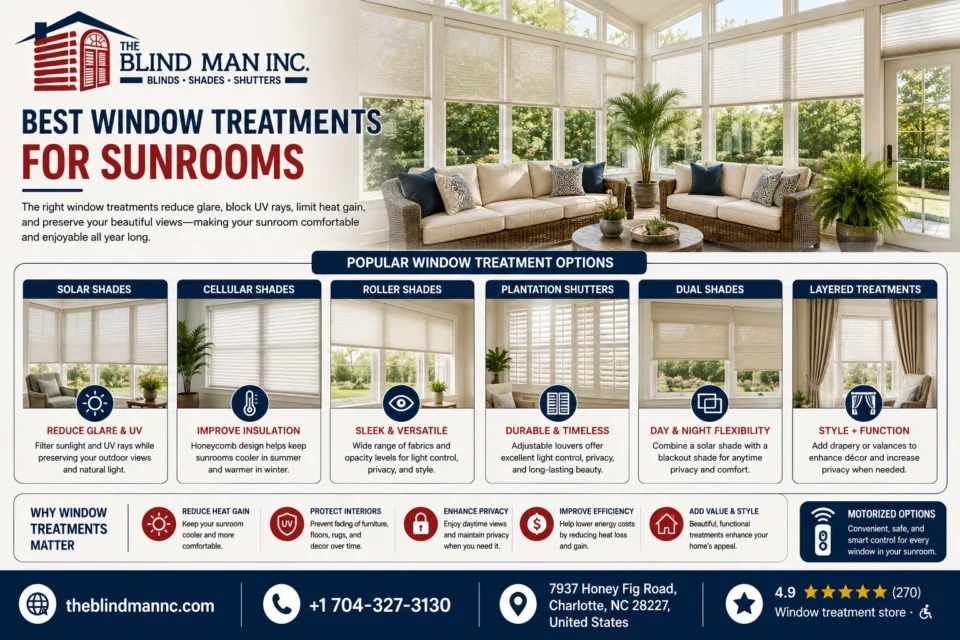
Layered Window Treatments
Some homeowners combine two different treatment types to improve both function and appearance.
Examples include:
- Solar shades with drapery panels
- Cellular shades with decorative curtains
- Roller shades with side panels
- Plantation shutters with a fabric valance
- Solar shades with an additional privacy layer
Layering allows homeowners to balance glare reduction, insulation, privacy, and design. However, it also adds cost and may require more space around the window.
Exterior Solar Screens
Exterior solar screens are mounted outside the window and help block sunlight before it reaches the glass.
They can reduce solar heat effectively, but they may be less convenient to adjust than interior shades. Exterior products also face weather exposure and may require different maintenance.
They may be considered when intense sun exposure is the main concern and preserving the interior window area is important.
How Do Window Treatments Improve Energy Efficiency?
Sunrooms can be difficult to heat and cool because glass transfers temperature more easily than insulated walls.
Window treatments can improve comfort by reducing direct heat gain, slowing heat loss, and creating an additional barrier near the glass.
Reducing Summer Heat
Solar shades help reduce the amount of direct sunlight entering the room. Cellular shades create insulating air pockets, while shutters and opaque roller shades block a greater portion of sunlight when closed.
The effectiveness of a treatment depends on:
- Fabric color
- Opacity
- Fit
- Window direction
- Installation method
- Glass type
- Time of day
- Whether the treatment is fully lowered
A well-fitted shade usually performs better than one with large gaps around the edges.
Retaining Warmth in Cooler Weather
During cooler months, cellular shades and tightly fitted shutters may help reduce drafts and slow heat loss near windows.
They do not replace insulated windows or proper weather sealing, but they can make the room feel more comfortable.
Opening the treatments on sunny winter days may allow natural warmth into the room. Closing them after sunset can help retain some of that heat.
Supporting HVAC Performance
A very hot sunroom can affect the comfort of nearby rooms, especially when the space is open to the rest of the home.
Reducing solar heat may lower the need for constant fan use or frequent thermostat adjustments. The improvement depends on the size and condition of the windows, the home’s insulation, and the selected treatment.
Protecting Furnishings
Energy efficiency is not only about indoor temperature. UV protection can also extend the life of expensive furnishings and finishes.
Replacing faded flooring, rugs, and upholstery can be costly. Window treatments that filter UV rays may help preserve these materials longer.
Using Treatments Strategically
Homeowners can adjust window treatments based on the season and time of day.
During hot weather:
- Lower shades before direct sunlight reaches the windows
- Close west-facing treatments in the afternoon
- Use solar fabrics where views matter
- Use insulating treatments on the hottest exposures
During cooler weather:
- Open shades on sunny windows during the day
- Close them after sunset
- Check for drafts around the frame
- Use cellular shades where insulation is a priority
Motorization can make these routines easier to maintain.
Should You Choose Motorized Window Treatments for a Sunroom?
Motorized window treatments can be especially useful in sunrooms because these spaces often contain many large or hard-to-reach windows.
Instead of adjusting each shade manually, homeowners can raise or lower multiple treatments using a remote, wall switch, smartphone, or smart-home system.
Convenience
A sunroom may include six, eight, or more individual windows. Adjusting each treatment by hand can become repetitive, particularly when sunlight changes throughout the day.
Motorization allows several shades to move together. Homeowners may create preset positions for:
- Morning light
- Afternoon glare
- Evening privacy
- Television viewing
- Maximum heat reduction
- Full outdoor visibility
Hard-to-Reach Windows
Sunrooms sometimes include clerestory windows, skylights, or tall glass panels. Motorized treatments make these windows easier to manage without ladders or extension poles.
This can improve both convenience and safety.
Smart Scheduling
Some motorized systems can follow a schedule.
Shades may be programmed to:
- Lower before peak afternoon sun
- Open gradually in the morning
- Close at sunset
- Adjust when the home is unoccupied
- Coordinate with lighting or temperature systems
Scheduled control can improve comfort and reduce the need to remember daily adjustments.
Accessibility
Motorization may be helpful for homeowners with limited mobility, arthritis, shoulder problems, or difficulty reaching large windows.
It also eliminates the need for exposed operating cords.
Child and Pet Safety
Cordless and motorized systems reduce dangling cords and loops. This makes them a practical option in homes with children or pets.
Power Options
Motorized treatments may use:
- Replaceable batteries
- Rechargeable batteries
- Plug-in power
- Low-voltage wiring
- Hardwired electrical connections
- Solar charging in some systems
The best power source depends on window access, product size, and how often the shades will be operated.
Cost Considerations
Motorization increases the initial cost, especially when many windows are involved. However, the convenience may justify the investment in a large sunroom.
Homeowners should consider:
- Number of windows
- Window height
- Daily adjustment needs
- Battery access
- Smart-home compatibility
- Motor warranty
- Noise level
- Future maintenance
Motorization is not necessary for every sunroom. It is most valuable when several treatments need to be adjusted frequently or when windows are difficult to reach.
How The Blind Man Can Help
Selecting window treatments for a sunroom requires careful attention to window direction, room temperature, privacy needs, outdoor views, and daily usage.
The Blind Man can evaluate how sunlight moves through the room and help homeowners compare solar shades, cellular shades, roller shades, plantation shutters, dual shades, and motorized options.
A professional consultation may include:
- Reviewing glare at different times of day
- Comparing solar openness factors
- Identifying windows with the greatest heat gain
- Measuring large or unusual windows
- Discussing daytime and nighttime privacy
- Evaluating fabric durability
- Comparing manual and motorized controls
- Coordinating treatments with the room’s design
Homeowners can also explore available Window Treatments suited to different levels of UV protection, insulation, privacy, and light control.
The goal is not to use the same treatment on every window. A professional assessment can help homeowners choose a balanced combination that protects the room while preserving the bright, open character that makes a sunroom appealing.
FAQs
What is the best window treatment for a very hot sunroom?
Cellular shades provide strong insulation, while solar shades help reduce direct solar heat and glare. The best choice depends on whether preserving the outdoor view or maximizing insulation is the greater priority.
Do solar shades provide enough privacy for a sunroom?
Solar shades provide limited daytime privacy, but people may be able to see inside at night when the interior lights are on. A second shade, curtains, or a dual-shade system may be needed for nighttime privacy.
What openness factor is best for sunroom solar shades?
A lower openness factor provides greater glare reduction and UV protection but reduces the clarity of the outdoor view. A higher openness factor preserves more visibility but allows more sunlight and heat to pass through.
Are cellular shades good for large sunroom windows?
Yes, although very large windows may require reinforced hardware, multiple shade panels, or motorization. Professional measurement helps prevent sagging and uneven operation.
Do plantation shutters make a sunroom too dark?
Plantation shutters can reduce brightness when fully closed, but adjustable louvers allow homeowners to direct sunlight while maintaining some natural light. Their frames and louvers may partially obstruct the view.
Can roller shades block all sunlight?
Blackout roller shades can block nearly all light passing through the fabric. However, light may still enter around the edges unless side channels or specialized mounting methods are used.
Are motorized shades worth it in a sunroom?
Motorized shades are often worthwhile when a sunroom has many windows, tall windows, or treatments that need frequent adjustment. They can improve convenience, accessibility, and consistent sun control.
Which window treatment offers the best UV protection?
Solar shades are specifically designed to filter UV rays while preserving the view. Opaque roller shades, shutters, and some cellular fabrics can also provide strong UV protection when fully closed.
Can window treatments reduce sunroom cooling costs?
They may help reduce solar heat gain and make the room easier to cool. Results depend on the treatment, fit, window condition, insulation, and how consistently the shades are used.
Should every sunroom window use the same treatment?
Not necessarily. Different window directions may require different openness factors, fabrics, or treatment types. A coordinated combination can provide better performance than using one product throughout the room.
What is the easiest sunroom window treatment to clean?
Plantation shutters are easy to wipe clean, while solar and roller shades can usually be dusted or vacuumed gently. Cellular shades require more care because dust may collect inside the fabric cells.
How do I protect sunroom furniture from fading?
Use UV-filtering window treatments, rearrange furniture periodically, and lower shades during the strongest sunlight. Solar shades are particularly useful when homeowners want UV protection without losing the outdoor view.
Are dual shades a good option for sunrooms?
Yes. Dual shades combine two fabrics, often a solar layer for daytime use and an opaque layer for nighttime privacy. They provide flexibility but usually cost more than a single shade.
How often should sunroom window treatments be replaced?
Replacement timing depends on the material, sun exposure, operating system, and maintenance. Treatments may need replacement when they become faded, warped, difficult to operate, damaged, or no longer provide adequate heat and glare control.
Share this article
Latest articles
October 13, 2026
October 13, 2026
October 13, 2026