
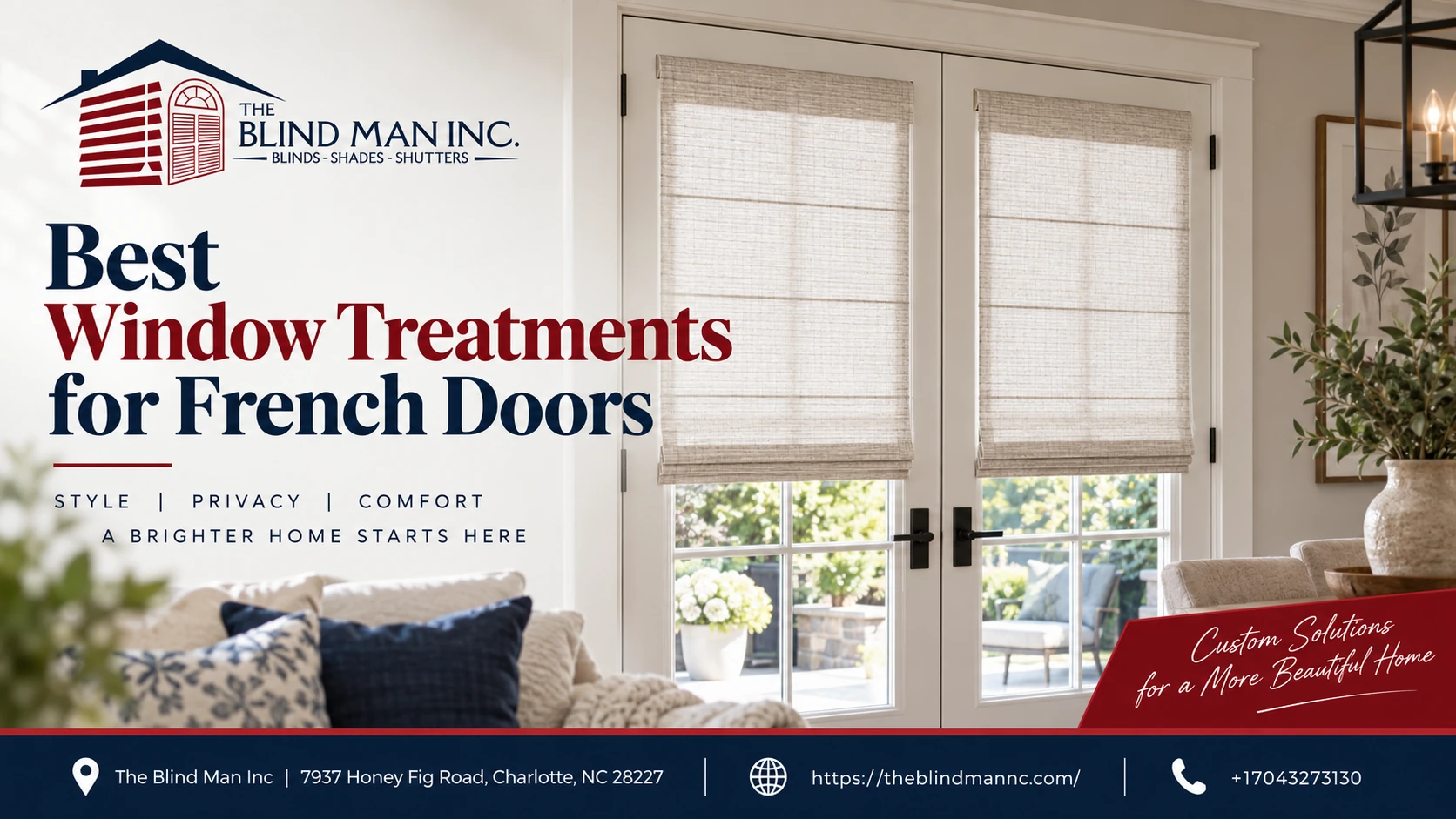
The best window treatments for French doors are those that provide privacy and light control without interfering with the door handle, swing, or daily use. Low-profile blinds, roller shades, cellular shades, and other door-mounted treatments are often strong choices because they can move with the door and remain neatly contained.
French doors are attractive because they bring in natural light and create an open connection between rooms or outdoor spaces, but their narrow glass panels and operating hardware make them more challenging to cover than standard windows. Choosing the right treatment means balancing appearance with practical details such as mounting depth, handle clearance, movement, and how often the doors are opened.
What Makes French Doors Challenging for Window Treatments?
French doors are different from ordinary windows because the treatment must work with a moving surface.
A shade or blind that performs perfectly on a fixed window may become inconvenient when installed on a door that opens and closes throughout the day.
The main challenges include:
- Limited mounting space around the glass
- Door handles and lock hardware
- Constant movement
- Narrow glass panels
- Need for privacy
- Direct sunlight through large glass areas
- Maintaining a clean appearance from both sides of the door
Handle clearance is one of the biggest concerns.
Many French doors have lever-style handles that extend across part of the glass area. A bulky headrail, thick blind, or poorly positioned shade can interfere with the handle or prevent the treatment from lowering completely.
Door movement also matters.
If a blind hangs freely, it may swing or knock against the door every time someone opens it. Treatments designed for French doors should therefore remain as close to the door surface as possible.
That often means using hold-down brackets or selecting low-profile products designed for door installation.
What Are the Best Window Treatments for French Doors?
Several types of window treatments can work well on French doors, but the best choice depends on how the doors are used.
Popular options include:
Roller Shades
Roller shades are one of the cleanest options for French doors.
They sit relatively close to the glass and are available in a wide range of materials, including:
- Light-filtering fabrics
- Room-darkening fabrics
- Blackout fabrics
- Solar screen materials
- Decorative textiles
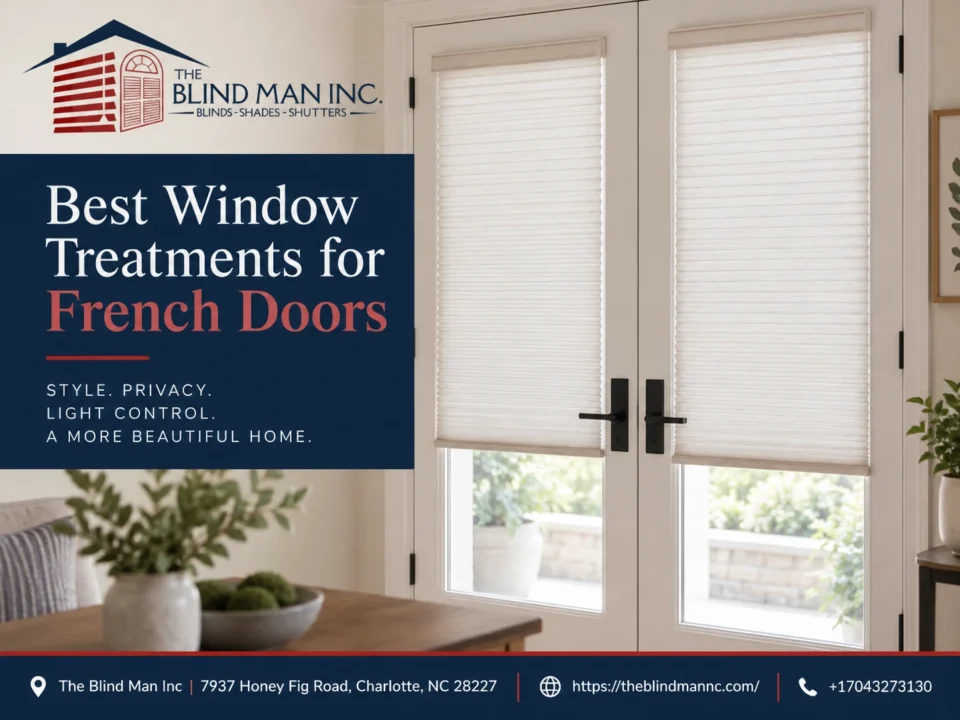
Because the shade rolls neatly into a compact top section, it usually takes up less visual space than bulkier treatments.
Roller shades are especially useful when homeowners want a modern, streamlined appearance.
Cellular Shades
Cellular shades are another practical option.
Their pleated honeycomb construction creates a soft appearance while offering privacy and potential insulation benefits.
They can be particularly useful on exterior French doors where temperature control is a concern.
Cellular shades also have a relatively slim profile, helping them fit around door hardware more easily.
Wood or Faux Wood Blinds
Horizontal blinds can work well when homeowners want adjustable light control.
The slats can be tilted without raising the entire blind, allowing homeowners to reduce glare while still letting some daylight into the room.
Faux wood may be especially useful on exterior doors exposed to humidity or temperature changes.
However, horizontal blinds require careful measurement because the headrail and slats need sufficient clearance around the handle.
Roman Shades
Roman shades can provide a softer and more decorative look.
They are particularly attractive in traditional, transitional, or elegant interiors.
Because the fabric stacks at the top when raised, homeowners should make sure there is enough space above the glass and that the folded fabric does not interfere with door operation.
Woven Shades
Woven wood shades can add warmth and texture to French doors.
They are often chosen for casual, coastal, natural, or transitional interiors.
Depending on the material, a privacy or blackout liner may be added when greater light control is needed.
The right option depends on the home’s style, the amount of privacy required, and how frequently the doors are used.
Are Blinds a Good Choice for French Doors?
Yes. Blinds can be a practical choice for French doors when they are properly sized and installed.
One of their biggest advantages is adjustable light control.
Instead of raising the entire treatment, homeowners can tilt the slats to change how much light enters the room.
This can be useful throughout the day as sunlight changes direction.
Blinds can also provide:
- Good privacy
- Familiar operation
- A structured appearance
- Multiple material choices
- Easy coordination with other blinds in the home
Faux wood blinds are often preferred on exterior French doors because they tend to handle moisture and temperature changes better than natural wood.
Real wood can still be an attractive option in climate-controlled interiors, especially when homeowners want a more natural or premium appearance.
One potential drawback is movement.
Because blinds are made from individual slats, they can rattle or swing when the door opens.
Hold-down brackets can help keep the bottom rail secured to the door.
Without them, the blind may move every time the door is used.
Are Shades Better Than Blinds for French Doors?
Shades are not automatically better than blinds, but they can be more convenient for certain French door installations.
Shades typically have fewer moving parts and a flatter overall profile.
This can make them easier to position around door handles and locks.
Roller and cellular shades are particularly useful when homeowners want a simple treatment that stays close to the door.
Shades may be better when you want:
- A streamlined appearance
- Fewer moving components
- Strong privacy
- Fabric-based design options
- Blackout or room-darkening performance
- Minimal visual clutter
Blinds may be better when you want:
- Adjustable slats
- Precise daylight control
- A structured appearance
- Easy coordination with blinds on nearby windows
The choice often comes down to how much flexibility you want.
Blinds allow light to be redirected without fully opening the treatment. Shades generally provide either more coverage or less coverage depending on how far they are raised.
For homeowners who frequently adjust light levels throughout the day, blinds may offer more control.
For those who want a clean, simple look, shades may be the stronger choice.
Which Options Provide the Best Privacy?
Blackout or opaque shades generally provide the highest level of privacy because they prevent visibility through the treatment when fully lowered.
These may include:
- Blackout roller shades
- Opaque cellular shades
- Lined Roman shades
- Privacy-lined woven shades
Blinds can also provide excellent privacy when the slats are fully closed.
However, privacy can depend on slat angle.
If the slats are tilted open, people outside may still be able to see through the gaps.
Light-filtering shades vary considerably.
Some are designed to soften sunlight while still providing daytime privacy, but visibility may change at night when interior lights are on.
For doors facing:
- Sidewalks
- Neighboring homes
- Patios
- Streets
- Shared outdoor spaces
Homeowners should consider how the treatment performs both during the day and after dark.
Bedroom French doors or doors leading to private patios may require stronger privacy than doors connecting an interior dining room to a sunroom.
How to Choose Treatments That Do Not Interfere With Door Handles
Handle clearance should be checked before choosing any French door treatment.
This is one of the most common reasons a treatment that looks good on paper becomes frustrating after installation.
Homeowners should measure:
- Distance between the glass and handle
- Depth of the handle
- Width of the available mounting area
- Clearance around locks
- Space above the glass
- Space below the window opening
Low-profile treatments are generally easier to work around French door hardware.
Roller shades and cellular shades are often good options because they do not project far from the door.
Horizontal blinds may also work, but the headrail and slats need enough room to operate freely.
An outside-mounted treatment can sometimes be positioned higher or wider to avoid hardware.
However, the treatment should not extend so far that it catches on walls, trim, or another door when the French doors are opened.
Professional measurement can be especially useful here because small placement differences can determine whether the door operates comfortably.
What Window Treatments Work Best for Frequently Used French Doors?
Frequently used doors need treatments that are stable, easy to operate, and resistant to repeated movement.
Roller shades are often a strong choice because of their compact design and relatively simple operating mechanism.
Cellular shades can also work well when secured properly.
For blinds, hold-down brackets become especially important.
These brackets keep the bottom rail attached to the door so the blind does not swing every time someone enters or exits.
Treatments for high-use French doors should ideally have:
- Secure mounting hardware
- Minimal projection from the door
- Simple controls
- Durable materials
- Stable bottom rails
- Easy cleaning
- Comfortable handle clearance
Cordless operation can also be useful.
It reduces loose cords near the handle and creates a cleaner appearance.
Motorization may be another option for certain shade styles, particularly when homeowners want coordinated control across multiple doors or nearby windows.
The more frequently the door is used, the more important simplicity becomes.
An elaborate treatment may look attractive, but it can quickly become inconvenient if it needs to be moved out of the way every time the door opens.
How to Balance Light Control and Door Function
French doors are often installed specifically to bring more natural light into a room.
That means completely covering them all day can work against the original purpose of the doors.
A good treatment should give homeowners flexible control.
For example:
Light-Filtering Shades
These soften direct sunlight without making the room dark.
They can work well in:
- Living rooms
- Dining rooms
- Breakfast areas
- Sunrooms
Room-Darkening Shades
These reduce much more light while still allowing some brightness.
They may be useful in:
- Bedrooms
- Family rooms
- Home offices
Blackout Shades
These are better when strong darkness is required.
They may work well on French doors in:
- Bedrooms
- Nurseries
- Media rooms
Adjustable Blinds
Blinds offer flexible light control because the slats can be tilted throughout the day.
This can be useful when sunlight changes direction.
The key is to match the level of light control to the room rather than simply choosing the darkest option available.
A living room may benefit from filtered sunlight, while a bedroom may need much stronger control.
Common Installation Mistakes to Avoid
Even the right product can become inconvenient when installed incorrectly.
Ignoring Handle Clearance
A shade should never block comfortable access to the door handle or lock.
Measure the full movement of the handle, not just the distance from the glass.
Choosing a Treatment That Is Too Wide
A treatment that extends too far beyond the door can catch on nearby trim, walls, or the second French door.
This is especially important when both doors open.
Skipping Hold-Down Brackets
Blinds and some shades can swing when a door moves.
Hold-down brackets can keep the treatment close to the door.
Installing Bulky Hardware
Large headrails may interfere with handles, decorative trim, or the door frame.
French doors generally benefit from compact hardware.
Forgetting About the Door Swing
Homeowners should open the door fully before installation and check whether the treatment will hit:
- Walls
- Furniture
- Curtains
- Another door
- Doorstops
Choosing Appearance Over Function
A beautiful treatment that must be adjusted every time someone uses the door can become frustrating.
Daily usability should remain a priority.
Measuring Only the Glass
The surrounding frame and available mounting area matter just as much as the glass dimensions.
Professional measurement helps account for the complete door structure.
How to Choose the Right Style for Your Home
French doors are visually prominent, so window treatments should complement both the doors and the surrounding room.
For Traditional Homes
Consider:
- Wood blinds
- Roman shades
- Woven shades
- Soft neutral fabrics
These can reinforce the architectural character of the room.
For Modern Interiors
Consider:
- Roller shades
- Simple cellular shades
- Neutral faux wood blinds
- Motorized shades
Clean lines and minimal hardware usually work best.
For Transitional Spaces
A combination of classic materials and simplified shapes often works well.
Examples include:
- Neutral Roman shades
- Light wood blinds
- Textured roller shades
- Cellular shades in soft colors
Coordinate With Nearby Windows
French door treatments do not have to match nearby windows exactly, but they should feel related.
Homeowners can create continuity through:
- Similar colors
- Matching materials
- Repeated textures
- Consistent hardware finishes
- Coordinated shade opacity
For example, a room may use roller shades on French doors and the same fabric on nearby windows.
That creates visual consistency without forcing every opening to use the same treatment style.
Keep the Door’s Design Visible
French doors are often an architectural feature.
The treatment should enhance rather than hide them.
Simple, properly scaled treatments usually preserve the character of the door better than oversized or heavily layered coverings.
The best window treatments for French doors balance privacy, light control, handle clearance, and everyday operation. A treatment that fits properly and moves comfortably with the door will generally provide better long-term satisfaction than one chosen for appearance alone.
FAQs
What is the best window treatment for French doors?
Roller shades, cellular shades, blinds, and Roman shades can all work well. The best choice depends on handle clearance, privacy needs, light control, and how frequently the doors are used.
Can you put blinds directly on French doors?
Yes. Blinds can be mounted directly to the door when there is enough space around the glass and handle. Hold-down brackets can help prevent the blind from swinging when the door moves.
Are roller shades good for French doors?
Yes. Roller shades are often a strong choice because they have a compact profile, offer multiple levels of light control, and can remain relatively close to the door surface.
Should French door shades be inside or outside mounted?
French door treatments are commonly mounted directly onto the door rather than inside the glass opening. The exact placement depends on the available frame space, hardware, glass dimensions, and treatment style.
How do you keep blinds from swinging on a French door?
Hold-down brackets can secure the bottom rail to the door, helping prevent movement when the door opens and closes.
What is best for privacy on French doors?
Opaque roller shades, blackout shades, cellular shades, lined Roman shades, and fully closed blinds can all provide strong privacy. The right option depends on how much light you still want to enter.
Can French door shades be motorized?
Some roller, cellular, and other shade styles can be motorized. Motorization may be useful when coordinating several doors and windows or when homeowners prefer remote or automated operation.
Do French doors need the same treatment as nearby windows?
Not necessarily. Different treatment types can be used as long as the colors, materials, or overall design remain coordinated.
Are curtains a good option for French doors?
Curtains can work, especially when mounted above the entire door opening, but they may be less convenient on frequently used doors. Door-mounted shades or blinds are often easier for everyday operation.
What should I measure before ordering French door window treatments?
Measure the glass, available mounting area, door width, handle clearance, lock placement, and the distance between the treatment area and surrounding trim. Also check the door’s full swing before selecting the final size.
Share this article
Latest articles
October 13, 2026
October 13, 2026
October 13, 2026