
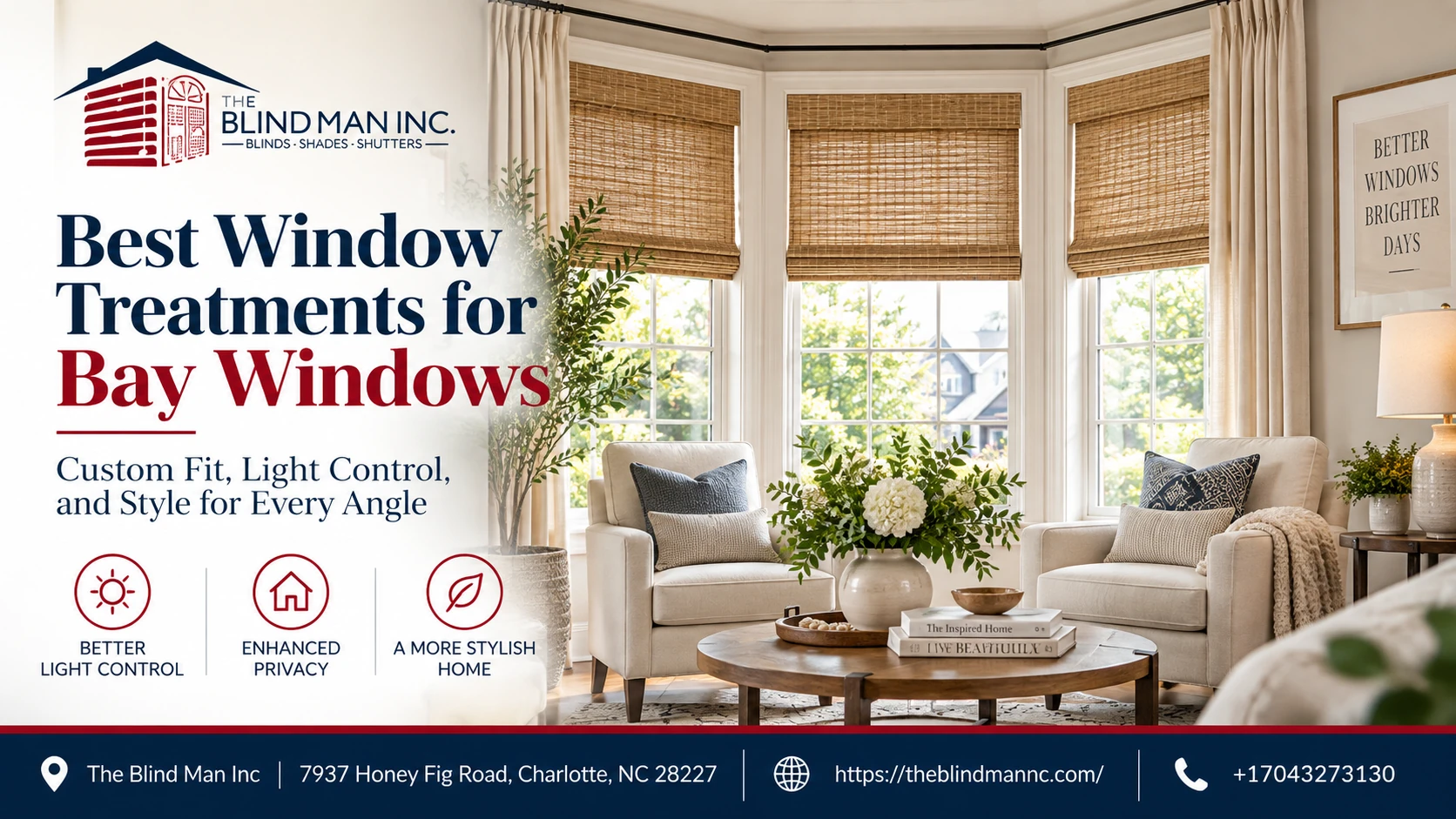
The best bay window treatments are custom-fitted shutters, shades, or blinds that control privacy and sunlight without hiding the architectural shape of the window. Because bay windows contain multiple angled sections, each panel usually needs to be measured and treated carefully so the coverings operate properly and do not interfere with one another.
Plantation shutters are especially attractive for bay windows because they follow the window’s structure and provide adjustable light control. Custom shades and blinds can also work well when homeowners want a softer, more streamlined look. The right choice depends on window depth, panel angles, privacy needs, decorating style, and how much natural light you want to preserve.
Why Are Bay Windows Challenging to Cover?
Bay windows are visually impressive because they project outward from the home and typically include three or more glass sections positioned at different angles.
That same architecture makes them more complicated to cover than a standard flat window.
A normal rectangular window generally requires one set of measurements and one treatment. A bay window may require separate measurements for:
- The center window
- Left and right side panels
- Individual mounting depths
- Corner angles
- Window handles or locks
- Trim and molding
- Sills or built-in seating
The treatments also need enough clearance to operate without hitting one another.
For example, blinds installed on two angled sections may collide at the corner if their headrails or slats extend too far. Shades can have similar problems if their mounting hardware is too wide.
Bay windows also create a design challenge.
Homeowners often choose bay windows because they bring more light into the room and create architectural depth. Covering the entire opening with a heavy treatment can hide those features.
The goal should be to improve privacy and light control while preserving the bay window’s shape.
That is why professionally measured window treatments can be particularly valuable for these installations.
What Are the Best Window Treatments for Bay Windows?
Several types of window treatments can work well on bay windows.
The best choice depends on whether homeowners prioritize architectural appearance, privacy, insulation, flexibility, or ease of operation.
Popular options include:
Plantation Shutters
Plantation shutters provide a structured, built-in appearance.
Each bay window section can receive its own shutter panel, allowing the treatment to follow the angles of the window rather than covering the bay as one large opening.
They provide:
- Adjustable light control
- Strong privacy
- A clean architectural appearance
- Long-term durability
- Easy maintenance
- Individual control over each section
Cellular Shades
Cellular shades provide a softer appearance and can help improve comfort around large areas of glass.
Their slim profile can also make them easier to install in tight bay window sections.
Roller Shades
Roller shades are useful when homeowners want simple, minimal window coverings.
They can be installed separately on each window panel and rolled almost completely out of sight when maximum daylight is desired.
Roman Shades
Roman shades bring fabric and softness to a bay window.
They work especially well when the bay is part of a bedroom, dining room, or formal living space.
Wood or Faux Wood Blinds
Blinds provide flexible light control because their slats can be tilted independently.
They can also coordinate with blinds elsewhere in the home.
The right product should complement the bay window rather than overwhelm it.
Are Plantation Shutters a Good Choice for Bay Windows?
Yes. Plantation shutters are often one of the strongest choices for bay windows because they can be custom-built to follow the shape of each section.
Rather than placing one large covering across the front of the bay, shutters can be fitted directly to the individual window openings.
This preserves the architectural depth of the bay.
Why Shutters Work Well
Shutters offer a combination of structure and flexibility.
Homeowners can adjust the louvers to control sunlight without opening the entire panel.
For example, louvers on the side receiving direct afternoon sun can be partially closed while the center section remains open.
This gives homeowners precise control over individual areas of the bay.
Shutters can also provide strong privacy.
When the louvers are closed, they limit outside visibility while maintaining a tidy appearance from both inside and outside the home.
Shutters Complement Bay Window Architecture
Bay windows naturally have strong architectural lines.
Plantation shutters reinforce those lines rather than hiding them behind a continuous curtain.
They can work especially well in:
- Traditional homes
- Transitional interiors
- Southern-style homes
- Craftsman-inspired spaces
- Formal living rooms
- Dining rooms
- Primary bedrooms
White or neutral shutters can create a bright, timeless appearance, while stained wood finishes may complement rooms with natural cabinetry or flooring.
Custom Fit Matters
Bay windows vary significantly in angle and depth.
Even small measuring errors can cause neighboring shutter panels to interfere with each other.
Professional measurement is especially important when planning shutters for angled window sections.
Are Shades a Good Option for Bay Windows?
Yes. Shades are another versatile choice for bay windows, particularly when homeowners prefer a softer or more contemporary appearance.
The most practical approach is usually to install one shade on each window section.
That allows each shade to operate independently.
Roller Shades
Roller shades are among the simplest options.
They occupy relatively little visual space and can almost disappear when fully raised.
Homeowners can choose from:
- Light-filtering fabrics
- Solar materials
- Room-darkening fabrics
- Blackout materials
- Decorative textiles
Light-filtering roller shades are particularly useful when preserving natural daylight is a priority.
Cellular Shades
Cellular shades are useful when energy efficiency and comfort are concerns.
Bay windows contain a relatively large area of glass, which can make the space feel warmer or cooler depending on the season and sun exposure.
Cellular shades create insulating air pockets within their honeycomb construction.
They can also be raised completely when homeowners want an unobstructed view.
Roman Shades
Roman shades provide a more decorative option.
Their fabric folds add softness to the strong angles of a bay window.
However, homeowners should consider how much fabric will stack at the top when the shade is raised.
On smaller bay window sections, bulky folds may block more glass than expected.
A carefully selected fabric and mounting method can help avoid this problem.
Can Blinds Work Well on Bay Windows?
Yes. Wood and faux wood blinds can work very well on bay windows when properly measured.
Their biggest advantage is adjustable light control.
Instead of raising the entire blind, homeowners can tilt the slats to redirect sunlight.
This can be particularly useful because different sections of a bay window may receive sunlight at different times.
For example:
- One side may receive morning sun.
- The center may receive balanced daylight.
- The opposite side may receive stronger afternoon exposure.
Individual blinds allow each section to be adjusted separately.
Wood Blinds
Real wood blinds provide a natural, premium appearance.
They can complement:
- Hardwood flooring
- Wood furniture
- Cabinetry
- Traditional interiors
They are also relatively lightweight, which can be useful on larger window sections.
Faux Wood Blinds
Faux wood is typically more resistant to moisture and easier to clean.
It may be useful when a bay window is located in:
- A kitchen
- Breakfast area
- Bathroom
- High-traffic family space
The main challenge is corner clearance.
Blinds installed too close together may collide where the bay sections meet.
Custom sizing helps prevent this problem.
How to Maintain Natural Light and Privacy
One of the reasons homeowners love bay windows is the amount of natural light they bring into a room.
The window treatment should preserve that benefit whenever possible.
Use Independent Treatments
Covering each window section separately provides greater control than using one large treatment across the entire opening.
Homeowners can close only the sections where privacy or glare is needed.
Choose Adjustable Treatments
Plantation shutters and blinds are particularly useful because their louvers or slats can be tilted.
Instead of choosing between fully open and fully closed, homeowners can redirect light while maintaining privacy.
Consider Light-Filtering Shades
Light-filtering fabrics soften direct sunlight without making the room dark.
They can be especially useful for:
- Living rooms
- Breakfast areas
- Dining rooms
- Home offices
Consider the View
If the bay window overlooks an attractive yard or landscape, choose treatments that can be raised or opened completely.
A bulky treatment that permanently covers part of the glass may reduce one of the window’s best features.
Think About Day and Night Privacy
Some light-filtering materials provide good privacy during the day but become less private after dark when interior lights are on.
Bedrooms and street-facing bays may require:
- More opaque fabrics
- Shutters
- Blinds
- Room-darkening shades
- Layered treatments
Privacy needs should be evaluated at different times of day.
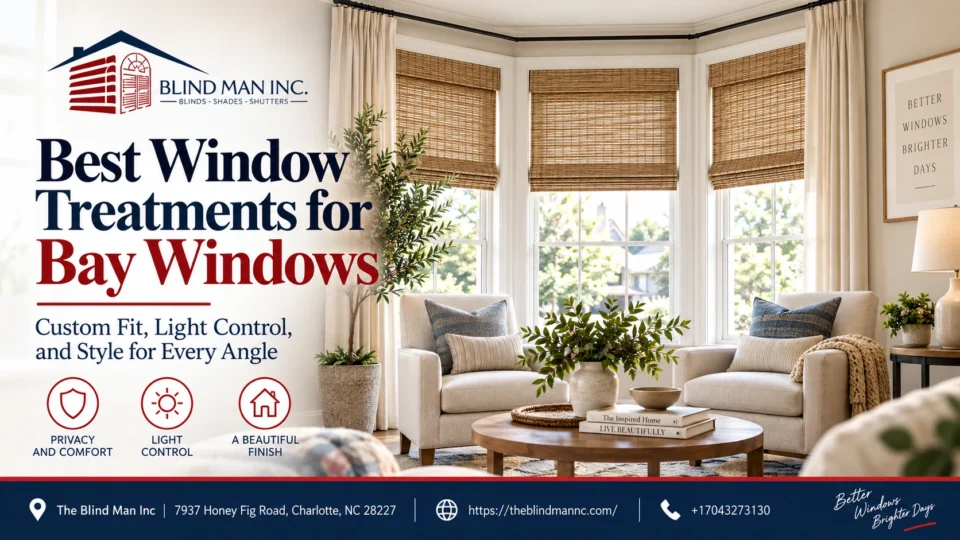
Should Each Bay Window Panel Be Covered Separately?
In many cases, yes.
Treating each window section individually is one of the most practical ways to preserve the shape and flexibility of a bay window.
Separate treatments allow homeowners to control:
- Light independently
- Privacy by section
- Glare
- Views
- Ventilation
- Individual window operation
This can be particularly useful when one window is operable and the others are fixed.
Individual treatments also emphasize the architectural structure.
Instead of hiding the bay behind one large covering, the treatments follow the individual panes and angles.
However, covering the entire bay as one opening can sometimes work.
For example, decorative drapery may be installed across the outer edge of the bay to create a dramatic, unified appearance.
Some homeowners combine both approaches.
They might use:
- Individual shades for practical light control
- Drapery around the entire bay for decoration
This creates flexibility while maintaining a finished look.
The best approach depends on the bay’s dimensions, depth, furniture placement, and architectural style.
How Custom Window Treatments Improve Fit and Appearance
Standard-size window treatments are designed primarily for common rectangular windows.
Bay windows rarely behave like standard openings.
Each section may have slightly different:
- Width
- Height
- Depth
- Trim
- Angle
- Hardware clearance
Custom treatments account for these differences.
Better Corner Clearance
The meeting points between bay window sections are critical.
Custom measurements help determine where each headrail, frame, or mounting bracket should stop.
This prevents neighboring treatments from colliding.
Cleaner Proportions
Poorly fitted blinds or shades can make an architectural window look less polished.
Custom sizing helps treatments align consistently across all sections.
Better Light Control
Large gaps around a shade or blind can allow unwanted sunlight into the room.
Precise sizing improves overall coverage.
Easier Window Operation
Custom planning also accounts for:
- Handles
- Cranks
- Locks
- Hinges
- Window screens
Treatments should not prevent homeowners from opening or cleaning the windows.
More Design Options
Custom treatments also make it easier to coordinate products across an entire bay.
Homeowners can choose consistent:
- Slat sizes
- Fabrics
- Colors
- Hardware finishes
- Operating systems
This creates a unified appearance even though each window section has its own treatment.
Best Design Ideas for Bay Window Treatments
Bay windows can become one of the strongest visual features in a room when treatments are selected thoughtfully.
Keep Treatments Simple
The architecture already creates visual interest.
Simple shades or shutters often allow the bay itself to remain the focus.
Use Plantation Shutters for an Architectural Look
Shutters can make the window feel integrated with the interior trim.
They are especially attractive when homeowners want a timeless, built-in appearance.
Use Roman Shades for Softness
A room dominated by hard surfaces may benefit from fabric.
Roman shades can soften the angles of the bay without requiring floor-length drapery.
Layer Shades With Drapery
Layering can create both function and style.
For example, individual cellular or roller shades can handle everyday privacy while drapery panels frame the entire bay.
Coordinate With a Window Seat
Many bay windows include a built-in bench.
Treatments should be selected so they do not interfere with cushions, seating, or storage.
Shorter window-mounted treatments usually work better than fabric that hangs directly onto the seat.
Keep Colors Neutral for Flexibility
White, cream, beige, soft gray, and natural wood tones tend to work well because they allow the bay’s architecture to remain prominent.
Bold fabrics can still work, but they should relate to other elements within the room.
Consider Motorization
Multiple shades can become tedious to operate individually.
Motorized treatments allow several window sections to move together.
This can be particularly useful for:
- Large bays
- Hard-to-reach windows
- Homeowners who adjust treatments several times per day
Extend Drapery Beyond the Bay
In some rooms, a curtain rod can be positioned across the front of the bay rather than following every angle.
This can create a cleaner appearance when the drapes are intended primarily for nighttime privacy.
However, homeowners should consider whether the curtain will block access to the bay seat or interior floor space.
How to Choose the Right Option for Your Bay Window
The right bay window treatments should solve practical problems without taking away from the architecture.
Start by identifying what the room actually needs.
Choose Plantation Shutters If You Want:
- A timeless architectural appearance
- Precise louver control
- Strong privacy
- Durable construction
- Easy maintenance
- Independent control over each window section
Choose Roller Shades If You Want:
- Minimal visual bulk
- A modern look
- Flexible fabric choices
- Simple operation
- Maximum visibility when raised
Choose Cellular Shades If You Want:
- A softer appearance
- Additional insulation
- Privacy
- Light-filtering or room-darkening options
- Compact operation
Choose Blinds If You Want:
- Adjustable slat control
- A familiar appearance
- Multiple material options
- Easy coordination with other windows
Choose Roman Shades If You Want:
- Decorative fabric
- A softer traditional or transitional style
- Strong visual impact
- Custom colors or patterns
Also consider how the bay interacts with the rest of the room.
A Charlotte home with a traditional dining room may benefit from fitted plantation shutters, while a more contemporary property may look better with streamlined roller shades.
Homeowners looking for professionally fitted options can explore our window treatments and plantation shutters or visit our Charlotte NC Window Treatments Page for location-specific information.
The best treatment is ultimately the one that preserves the architectural character of the bay while giving homeowners practical control over privacy, daylight, glare, comfort, and everyday operation.
FAQs
What is the best window treatment for a bay window?
Plantation shutters, roller shades, cellular shades, Roman shades, and blinds can all work well. The best option depends on the window angles, mounting depth, privacy needs, light control, and interior style.
Are plantation shutters good for bay windows?
Yes. Plantation shutters are particularly well suited to bay windows because they can be custom-fitted to individual sections. Their louvers provide flexible privacy and light control while preserving the architectural shape of the bay.
Should bay windows have separate blinds?
Separate blinds are usually practical because they allow each section to be adjusted independently. Custom measurement is important to prevent neighboring blinds from interfering with each other at the corners.
Can you put roller shades on bay windows?
Yes. Roller shades have a compact design that works well on individual bay window sections. Light-filtering, room-darkening, blackout, and solar fabrics are available depending on the room’s needs.
Are cellular shades suitable for bay windows?
Yes. Cellular shades provide privacy and flexible light control while maintaining a relatively slim profile. Their honeycomb construction may also help improve comfort around large areas of glass.
Can you put curtains on a bay window?
Yes. Curtains can follow the shape of the bay using specialized hardware or span the front of the entire opening. They can also be layered with individual blinds or shades.
How do you create privacy without blocking light in a bay window?
Adjustable shutters, blinds, and light-filtering shades can provide privacy while maintaining daylight. Treating each section independently also allows homeowners to cover only the windows where privacy is currently needed.
Do bay window treatments need to be custom-made?
They do not always have to be custom-made, but custom sizing is often beneficial because bay windows have unusual angles, varying dimensions, and limited mounting clearance. Precise measurement helps improve appearance and operation.
Should all three sections of a bay window match?
They generally look best when the treatments coordinate in color, material, and style. However, each section can still be sized and operated independently.
Can bay window treatments be motorized?
Yes. Many roller, cellular, and other shade styles can be motorized. This can be particularly convenient when several treatments need to be adjusted together.
How do you prevent blinds from hitting each other in a bay window?
Careful measurement and proper mounting placement are essential. Each treatment needs enough clearance at the angled corners so headrails, slats, and operating mechanisms can move without colliding.
What color window treatments are best for bay windows?
Neutral colors such as white, cream, beige, soft gray, and natural wood tones are versatile because they complement many interiors and allow the bay window’s architecture to remain prominent.
Share this article
Latest articles
October 22, 2026

October 22, 2026
October 22, 2026