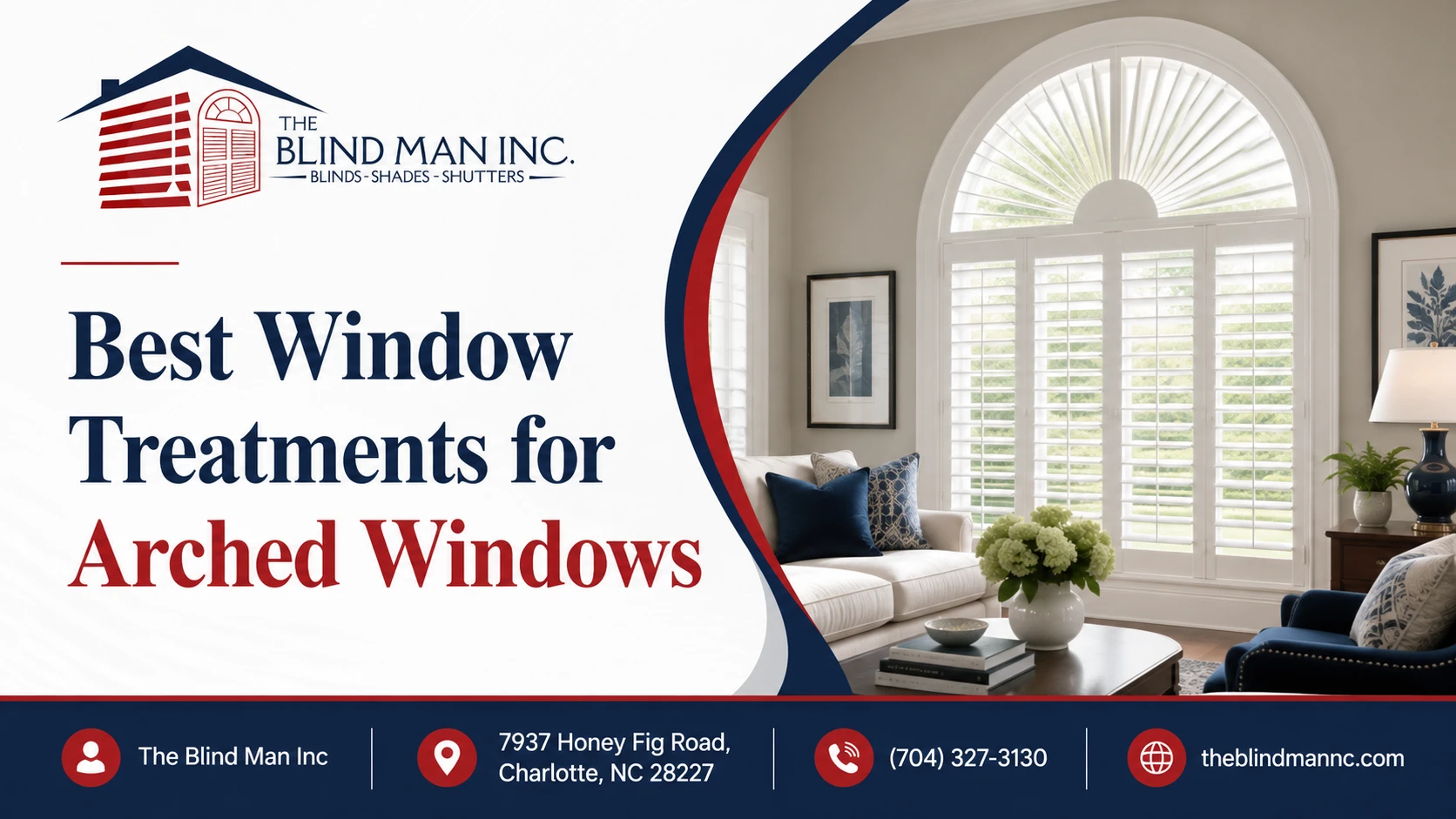
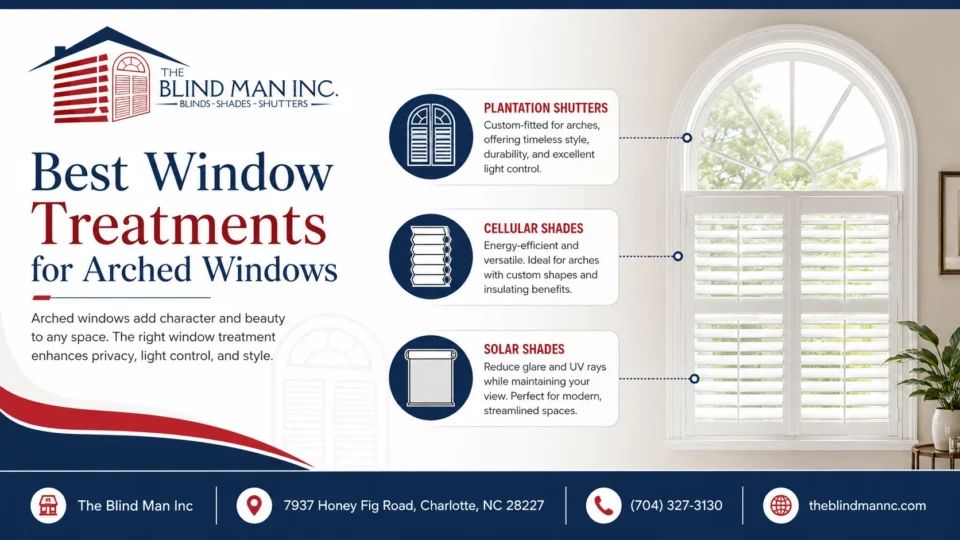
The best window treatments for arched windows are custom plantation shutters, specialty cellular shades, arched solar shades, and other coverings designed specifically for curved openings. The right option depends on whether the homeowner prioritizes privacy, light control, insulation, motorization, or preserving the window’s architectural shape.
Arched windows add character and elegance to entryways, living rooms, stairwells, and primary suites. However, their curved design makes them more difficult to cover than standard rectangular windows. Ready-made blinds and shades rarely fit correctly, and poorly matched treatments can hide the arch, leave unwanted gaps, or interfere with operation.
Choosing the right arched window treatments requires careful measuring and an understanding of how each product will function within the space. Custom solutions often provide the best combination of appearance, performance, and long-term reliability.
What Makes Arched Windows Challenging to Cover?
Arched windows do not follow the straight lines used for most blinds, shades, and shutters. Their curved tops may be perfect half circles, elongated arches, eyebrow shapes, quarter arches, or custom architectural designs.
These variations affect both product selection and installation.
Curved Shapes Require Precise Measurements
A standard rectangular window can usually be measured using width, height, and depth. An arched window may require additional dimensions, including:
- The height of the rectangular section
- The highest point of the arch
- The width at the spring line
- The radius or curve
- Frame depth
- Inside and outside edge measurements
- Differences between the left and right sides
Even small measuring errors can leave visible gaps or prevent the treatment from fitting inside the opening.
Some arches appear symmetrical but are slightly uneven due to framing, settling, trim work, or construction variations. This is why templates are often used for custom fabrication.
The Arch May Be Fixed or Operable
Some arched windows are decorative and do not open. Others are combined with casement, double-hung, or picture windows below.
The treatment should not interfere with:
- Handles
- Locks
- Cranks
- Hinges
- Screens
- Window ventilation
- Adjacent treatments
When the upper arch and lower window are part of the same opening, homeowners must decide whether they want one coordinated treatment or separate coverings for each section.
Light Enters at Different Angles
Arched windows are often placed high on walls or above doors, where they receive strong direct sunlight.
The curved upper section may allow glare and heat to enter even when the lower part of the window is covered. This can create bright spots, uneven room temperatures, and fading on nearby furnishings.
Charlotte homes with large south- or west-facing arches may experience especially strong afternoon sunlight.
Privacy Can Be Difficult to Manage
Arched windows are frequently installed above front doors, in two-story living rooms, or in primary bedrooms. Depending on their location, they may expose part of the interior to neighboring homes or the street.
A decorative uncovered arch may provide enough privacy during the day but become more noticeable at night when interior lights are on.
Standard Treatments May Hide the Architecture
One of the main reasons homeowners choose arched windows is their shape. Installing a rectangular curtain, shade, or blind over the entire opening may hide the curve completely.
A well-designed custom treatment follows the arch rather than covering it with a straight line. This preserves the architectural feature while adding practical light and privacy control.
Gravity Affects Shade Operation
Specialty shades designed for arches must remain supported within the curved frame. Standard roller or cellular shades may sag, bunch, or pull away from the opening.
Fixed specialty shades can fit the shape well, but adjustable or motorized options require more advanced hardware and careful installation.
Mounting Space May Be Limited
Arched windows may have shallow frames, decorative trim, or narrow mounting surfaces. The selected treatment must fit without damaging the molding or extending awkwardly into the room.
Professional measurement can determine whether an inside mount, outside mount, frame mount, or custom insert is most appropriate.
What Are the Best Window Treatments for Arched Windows?
The best choice depends on the window shape, room use, light exposure, privacy requirements, and desired appearance.
Custom Plantation Shutters
Custom plantation shutters are one of the most popular options for arched windows because they can be manufactured to follow the exact curve of the opening.
The frame is built to match the window shape, while the louvers can be arranged in several ways depending on the design.
Possible configurations include:
- Sunburst louvers
- Horizontal louvers
- Fan-shaped louvers
- Fixed upper louvers
- Operable louvers
- Separate upper and lower sections
- Full-height custom panels
Plantation shutters offer a finished architectural appearance that works well in traditional, transitional, and contemporary homes.
Benefits of Plantation Shutters
Custom shutters can provide:
- Precise fit
- Strong privacy
- Adjustable light control
- Long-term durability
- Easy cleaning
- Added insulation
- Timeless appearance
- Consistent curb appeal
- Coordinated design with lower windows
Their rigid structure makes them especially suitable for irregular or tall arched windows.
Light-Control Options
Some arched shutter designs use fixed louvers in the curved section. These louvers remain in one position but still filter light and add privacy.
Other custom designs allow the louvers to tilt. Operable louvers provide greater control but may require more complex construction.
The lower rectangular section can often be adjusted independently from the arch. This allows homeowners to close the lower shutters for privacy while leaving the top open for daylight.
Tradeoffs of Plantation Shutters
Plantation shutters may not be the best choice when homeowners want:
- A completely unobstructed view
- Full motorized operation
- A treatment that disappears when open
- A soft fabric appearance
- The lowest possible initial cost
The frame and louvers remain visible even when open. However, many homeowners view this as part of the architectural appeal.
Specialty Cellular Shades
Cellular shades can be custom fabricated for arched windows. Their honeycomb construction helps create an insulating layer between the window and the room.
These shades may be designed as fixed fan-shaped inserts or as operable specialty treatments.
Benefits of Cellular Shades
Cellular arched shades can offer:
- Improved insulation
- Reduced glare
- UV filtering
- Light-filtering or room-darkening fabrics
- A soft, lightweight appearance
- Multiple colors and fabric options
They are useful in rooms where temperature control is a major concern.
Fixed Cellular Arch Shades
A fixed cellular insert remains in place within the arch. It provides consistent light filtering but cannot be raised or lowered.
This option may be suitable for high windows that do not require frequent adjustment.
Operable Cellular Arch Shades
Some specialty systems allow the shade to open, close, or fan across the arch. These products offer more flexibility but require precise fitting and specialized hardware.
Motorized cellular options may be available for certain shapes and sizes.
Tradeoffs of Cellular Shades
Cellular shades may:
- Block the view when closed
- Collect dust within the cells
- Require careful cleaning
- Offer less architectural definition than shutters
- Have limited operating options for complex arches
They are often best for homeowners who prioritize insulation and soft light control.
Arched Solar Shades
Solar shades use woven fabric to reduce glare, UV exposure, and solar heat while allowing some visibility through the material.
Custom solar treatments may be designed for certain arched windows, although options depend on the exact shape and whether the homeowner wants fixed or movable coverage.
Benefits of Solar Shades
Solar shades may help:
- Reduce glare
- Filter UV rays
- Protect flooring and furniture
- Preserve some outdoor visibility
- Limit solar heat gain
- Maintain a clean, contemporary look
They can be particularly useful for bright living rooms, entryways, and south-facing windows.
Openness Factors
Solar fabrics are available in different openness levels. A lower openness percentage has a tighter weave, providing stronger glare reduction and UV protection. A higher percentage preserves more of the view but allows more light through.
Tradeoffs of Solar Shades
Arched solar shades may:
- Provide limited nighttime privacy
- Be available only as fixed inserts for some shapes
- Require specialized tracks or framing
- Allow some heat through the weave
- Offer fewer fabric choices than standard solar shades
They are best suited to homeowners who want to reduce harsh sunlight without completely covering the view.
Custom Roller Shades
A standard roller shade cannot follow a curved window shape, but a custom roller shade may be installed over the entire opening.
This approach uses a rectangular shade that covers both the arch and the lower portion of the window.
Benefits of Roller Shades
Roller shades provide:
- Broad fabric selection
- Light-filtering, room-darkening, and blackout options
- Motorized operation
- Clean appearance when raised
- Strong privacy when lowered
This may be a practical choice when function matters more than keeping the arch visible while the shade is closed.
Tradeoffs of Roller Shades
A rectangular roller shade will cover the architectural shape when lowered. It may also require mounting above or beyond the trim.
Homeowners should decide whether preserving the visible arch is more important than achieving simple, complete coverage.
Drapery and Custom Curtains
Custom drapery can be used around arched windows, particularly when the opening is large or part of a two-story wall.
Curtains may be mounted above the arch so they frame the entire window.
Benefits of Drapery
Drapery offers:
- Softness and texture
- Strong design impact
- Room-darkening options
- Improved privacy
- Additional insulation
- Flexible fabric selection
Tradeoffs of Drapery
Curtains may hide the arch when closed and require substantial wall space. Long panels may also be impractical near furniture, doors, or narrow entryways.
Drapery works best when homeowners want a layered, decorative look rather than a treatment that follows the curve precisely.
Decorative Window Film
Window film can reduce UV exposure and glare without adding a physical shade or shutter.
It may be useful for very high or decorative arches that do not require adjustable privacy.
Benefits of Window Film
Film can:
- Preserve the window shape
- Reduce UV exposure
- Limit glare
- Require minimal visual space
- Work on complex curves
Tradeoffs of Window Film
Window film does not provide adjustable light control. It may also offer limited nighttime privacy and cannot create room-darkening conditions.
Film is often used as a supplemental solution rather than a complete window treatment.
Layered Treatments
Some arched windows benefit from combining products.
Examples include:
- Plantation shutters with drapery
- Cellular arch inserts with lower blinds
- Solar arch shades with curtains
- Window film with lower shutters
- Fixed arch treatment with motorized lower shades
Layering can provide better privacy, insulation, and design flexibility, but it may increase cost and require more careful planning.
Why Are Custom Window Treatments Important for Arched Windows?
Custom fabrication is important because arched windows rarely match standard product dimensions. A made-to-fit treatment follows the actual curve, accounts for irregularities, and aligns with the surrounding trim.
A Precise Fit Improves Appearance
Visible gaps are more noticeable around curved windows than around rectangular ones. A poorly fitted treatment can make the arch look uneven or unfinished.
Custom treatments are designed to:
- Match the curve
- Follow the frame
- Align with lower windows
- Minimize gaps
- Preserve symmetry
- Coordinate with trim and molding
This creates a finished appearance from both inside and outside the home.
Custom Measurements Improve Light Control
Even a small gap can allow a noticeable beam of sunlight to enter through an arch. Precise measurements reduce unwanted glare and improve privacy.
For blackout or room-darkening applications, accurate templates and mounting details are especially important.
The Product Must Match the Exact Shape
Arched windows can include:
- Perfect arches
- Eyebrow arches
- Gothic arches
- Quarter arches
- Half arches
- Elliptical arches
- Asymmetrical curves
- Combination shapes
Each design requires a different fabrication approach. A product made for a perfect half-circle may not fit an elongated or uneven arch.
Material Selection Affects Performance
Custom planning allows homeowners to choose materials suited to the room.
For example:
- Wood shutters may suit dry living rooms
- Composite shutters may perform better in humid areas
- Cellular shades may improve insulation
- Solar fabric may reduce glare and UV exposure
- Blackout fabric may suit bedrooms or media spaces
Charlotte’s seasonal humidity and strong sunlight make material selection especially important.
Professional Templates Reduce Errors
Some arched treatments require a physical template of the opening. The template helps the manufacturer reproduce the exact curve.
This process is often more reliable than using width and height measurements alone.
Professional measuring can also identify whether the opening is:
- Out of square
- Uneven
- Too shallow
- Obstructed
- Difficult to mount
- Different from the visible trim shape
Custom Installation Protects the Product
Specialty treatments must be mounted securely and evenly. Improper installation may cause:
- Misaligned frames
- Sticking panels
- Gaps around the curve
- Uneven shade tension
- Hardware strain
- Damage to decorative trim
Professional installation helps protect both the treatment and the window.
Custom Solutions Preserve the Architecture
The purpose of an arched window is often visual. A custom product can provide practical coverage without making the window look like a standard rectangle.
This is especially important in front entryways, formal living rooms, and primary suites where the arch is a major design feature.
How Much Do Arched Window Treatments Typically Cost?
Arched window treatments generally cost more than comparable treatments for standard rectangular windows. The higher price reflects custom measuring, specialized fabrication, unique materials, and more involved installation.
There is no single average price that applies to every arch. Costs vary significantly based on the product and window.
Window Size
Large arches require more material, stronger frames, and additional installation time.
A small fixed arch above a standard window will typically cost less than a two-story arched opening or a wide entryway window.
Shape Complexity
A perfect half-circle is usually easier to measure and manufacture than an elliptical, eyebrow, Gothic, or asymmetrical arch.
More complex shapes may require:
- Detailed templates
- Additional design work
- Custom hardware
- Multiple panels
- Specialized fabrication
These factors increase labor and production costs.
Material Selection
Material has a major effect on price.
Natural hardwood plantation shutters typically cost more than vinyl or some composite options. Specialty cellular and solar fabrics also vary based on opacity, insulation, and UV performance.
Premium finishes, custom paint colors, and decorative details may add to the total.
Fixed vs. Operable Design
A fixed arch insert generally costs less than an operable treatment.
Operable designs require additional components, such as:
- Hinges
- Tilt systems
- Tracks
- Tension mechanisms
- Motors
- Remote controls
The more adjustable the treatment, the more complex the fabrication and installation usually become.
Motorization
Motorized specialty shades cost more than manual or fixed options.
The final price may depend on:
- Motor type
- Window size
- Battery or hardwired power
- Remote controls
- Wall switches
- Smart-home compatibility
- Access to electrical wiring
- Number of windows
Motorization is most valuable for high, oversized, or frequently adjusted arches.
Installation Difficulty
Installation costs may increase when the window is:
- Above a staircase
- Two stories high
- Located over a door
- Surrounded by decorative trim
- Difficult to reach
- Mounted in masonry
- Part of a grouped window system
Special equipment or additional installers may be required.
Inside vs. Outside Mounting
Inside mounts require enough depth and a reasonably consistent opening. Outside mounts may require larger frames or additional material to cover the area around the arch.
The mounting method can affect both material and installation costs.
Number of Windows
Ordering several matching arched treatments may increase the total project cost, but it can also create a more coordinated appearance throughout the home.
Homeowners should compare each window individually because similar-looking arches may have different dimensions.
Long-Term Value
Price should be considered alongside durability, appearance, energy performance, and expected lifespan.
A lower-cost treatment that fits poorly or cannot be adjusted may need to be replaced sooner. A properly measured custom product may provide better value by improving comfort, protecting furnishings, and maintaining the architectural character of the home.
How The Blind Man Can Help
The Blind Man can help homeowners evaluate the shape, dimensions, light exposure, and privacy needs of arched windows before choosing a treatment.
A professional consultation may include:
- Identifying the exact arch shape
- Measuring or creating a custom template
- Checking frame depth
- Evaluating sun and heat exposure
- Comparing fixed and operable options
- Reviewing shutter, cellular, solar, and roller solutions
- Selecting moisture-appropriate materials
- Discussing motorization
- Planning installation around trim and window hardware
- Coordinating the arch with lower window treatments
Custom plantation shutters are often a strong choice because they can follow the window’s shape while providing durable light and privacy control. Homeowners can explore available Plantation Shutters after the window’s dimensions and practical requirements have been evaluated.
The goal of professional guidance is not to make the treatment more complicated than necessary. It is to help homeowners avoid poor-fitting products and choose a solution that preserves the beauty of the arch while improving comfort and function.
FAQs
What is the best window treatment for an arched window?
Custom plantation shutters are one of the most versatile options because they can follow the curve and provide privacy, durability, and adjustable light control. Cellular, solar, and roller shades may also work depending on the homeowner’s goals.
Can plantation shutters fit any arch shape?
Custom shutters can be manufactured for many shapes, including perfect arches, eyebrow arches, quarter arches, and some asymmetrical openings. Extremely complex shapes may require specialized design.
Do arched window treatments have to be custom-made?
Most do. Standard products rarely match the exact curve, width, height, and depth of an arched window.
Can an arched window shade be motorized?
Some specialty cellular, roller, and solar shades can be motorized. Availability depends on the shape, size, mounting system, and manufacturer.
Are plantation shutters adjustable on arched windows?
Some arched shutters have operable louvers, while others use fixed louvers in the curved section. The lower portion may operate independently.
Do arched shutters block too much light?
They can be adjusted to control light, although the frame and louvers remain visible. Wider louvers may preserve more of the view than smaller ones.
Can cellular shades be used on arched windows?
Yes. Specialty cellular shades can be made as fixed fan inserts or, in some cases, operable treatments. They are especially useful for insulation and glare reduction.
Are solar shades suitable for arched windows?
Custom solar shades may be suitable when glare and UV protection are priorities. Options depend on whether the homeowner wants fixed or adjustable coverage.
How are arched windows measured for treatments?
Measurements may include width, total height, arch height, frame depth, radius, and multiple points along the curve. Some products require a physical template.
Can I measure an arched window myself?
Basic measurements may be possible, but professional measuring is recommended for custom products. Small errors can lead to visible gaps or an unusable treatment.
Are arched window treatments more expensive?
They usually cost more than standard treatments because they require custom measuring, fabrication, and installation.
What affects the cost of arched shutters?
Cost factors include size, shape complexity, material, louver configuration, finish, installation height, and whether the louvers are fixed or operable.
Can curtains be used on arched windows?
Yes. Curtains can be mounted above the arch to cover the entire opening, but they may hide the curved shape when closed.
How can I reduce heat from an arched window?
Solar shades, cellular shades, shutters, and UV-filtering film can reduce heat and glare. The best option depends on the amount of sunlight and whether the view should remain visible.
Are arched window treatments energy-efficient?
They can improve comfort by reducing direct sunlight and creating an additional barrier near the glass. Cellular shades and tightly fitted shutters may provide the greatest insulation benefits.
What is the best treatment for an arched bedroom window?
Plantation shutters, room-darkening cellular shades, or a custom roller shade covering the entire opening can provide privacy and reduce morning light.
Can the arch and lower window use different treatments?
Yes. A fixed treatment may cover the arch while blinds, shutters, or shades cover the lower window. The products should be coordinated for a consistent appearance.
How long do custom arched shutters last?
High-quality plantation shutters can last 20 to 30 years or longer with proper installation and maintenance.
Are arched shutters easy to clean?
Yes. They can usually be dusted with a microfiber cloth or vacuumed using a soft brush attachment. Curved and fan-shaped louvers may require slightly more care.
When is professional installation recommended?
Professional installation is strongly recommended for high, large, unusually shaped, or motorized arched treatments. It helps ensure accurate alignment, secure mounting, and smooth operation.
Share this article
Latest articles
October 13, 2026
October 13, 2026
October 13, 2026