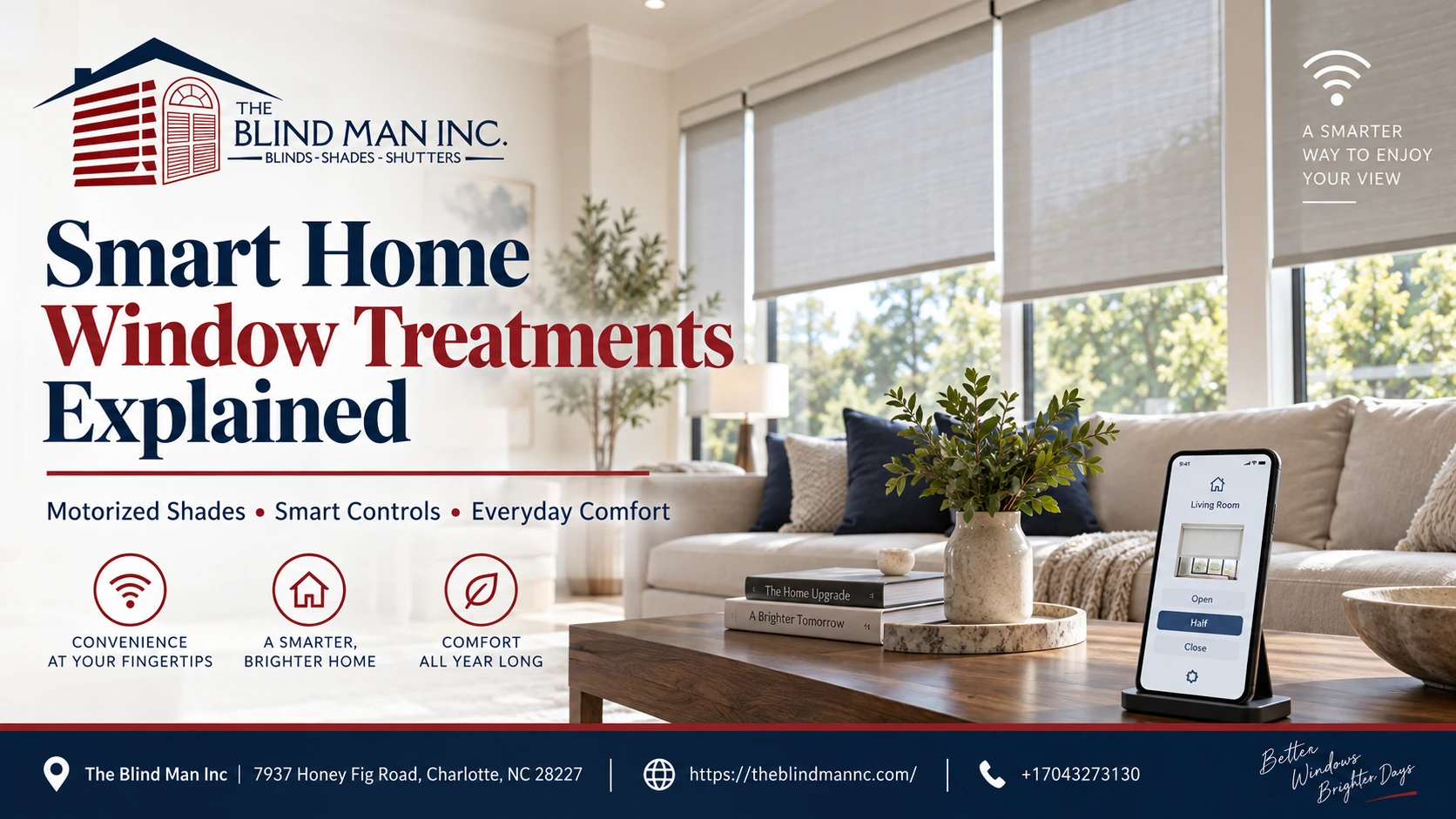
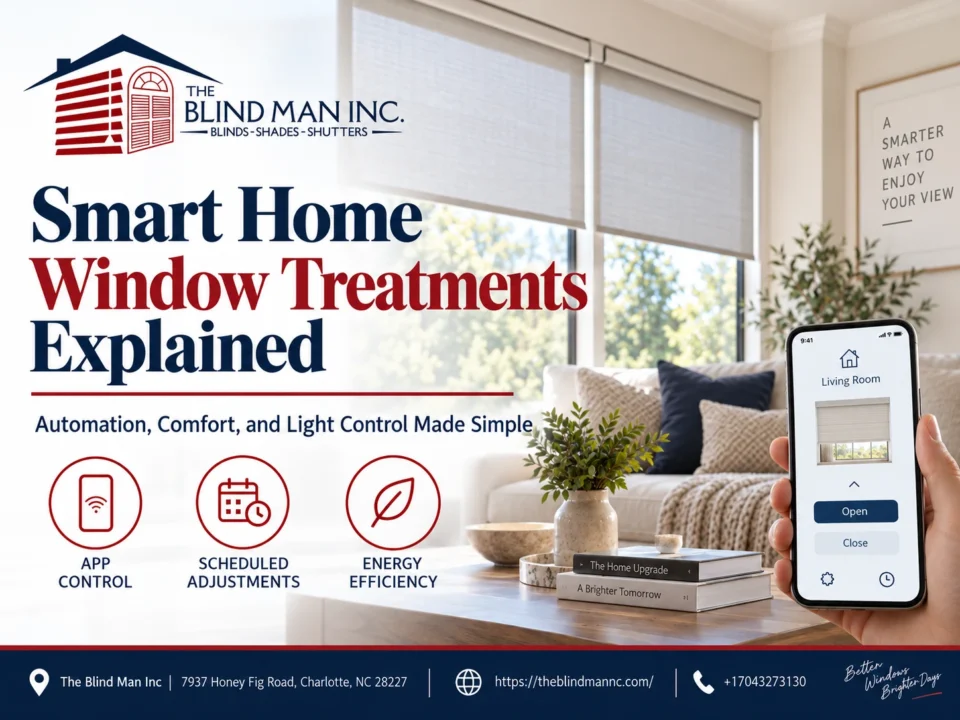
Smart home window treatments are motorized blinds or shades that can connect to an app, automation platform, or compatible smart-home system, allowing homeowners to control light and privacy without manually adjusting each window. Depending on the system, they can operate by remote control, smartphone, voice command, schedules, or automated routines.
Their biggest advantage is convenience, but automation can also improve comfort, privacy, glare control, and management of solar heat. The key is understanding that not every motorized shade is automatically a smart shade. Connectivity, compatibility, power source, controls, and installation requirements all need to be considered before choosing a system.
What Are Smart Home Window Treatments?
Smart home window treatments are shades, blinds, or other coverings equipped with motors and connected controls that allow them to operate automatically or remotely.
Instead of pulling a cord or manually raising a shade, homeowners may be able to control the treatment using:
- A handheld remote
- A smartphone application
- A wall-mounted control
- Voice commands
- Automated schedules
- Smart-home scenes
- Sensors or other connected devices
Some systems operate independently through their manufacturer’s app, while others integrate with larger smart-home platforms.
For example, compatible shades may be included in a “Good Morning” routine that raises selected shades, turns on lights, and adjusts the thermostat.
A nighttime routine might lower bedroom shades automatically while locking compatible doors and switching off selected lights.
The exact features depend on the shade motor, controller, communication technology, and smart-home platform being used.
Smart functionality is available with several window treatment styles, including roller shades, cellular shades, Roman shades, and certain blinds.
Homeowners should choose the actual window treatment based on privacy, light control, insulation, and design first, then determine which automation features they want.
How Do Smart Window Treatments Work?
Smart window treatments use a small motor built into the shade or blind system.
That motor raises, lowers, tilts, or otherwise adjusts the treatment when it receives a command.
Commands can come from several sources.
Remote Control
A basic handheld remote communicates directly with the motor.
This approach does not necessarily require Wi-Fi or a smart-home system.
Smartphone Application
Connected systems may allow homeowners to open, close, or position shades using an app.
Depending on the product and setup, control may be available while the homeowner is inside the house or remotely through an internet-connected platform.
Smart-Home Hub or Gateway
Some window treatment motors communicate with a dedicated hub or gateway, which then connects them to a broader smart-home platform.
For example, current professional systems can integrate with platforms including Amazon Alexa, Google Home, Apple Home and, depending on the product, Matter and professional automation systems. Compatibility varies significantly by motor and controller, so it should always be confirmed before ordering.
Voice Control
Once properly integrated, certain systems can respond to commands such as opening the living room shades or closing bedroom shades.
Automated Routines
Connected treatments can sometimes operate according to:
- Time of day
- Sunrise or sunset
- Preset scenes
- Household routines
- Other compatible smart-home triggers
The homeowner does not necessarily have to press anything at all.
That automation is where smart shades differ most clearly from basic motorized treatments.
What Is the Difference Between Motorized and Smart Window Treatments?
Motorized and smart window treatments are related, but they are not the same thing.
A motorized window treatment simply uses a motor instead of manual operation.
A smart window treatment adds connectivity and automation.
For example, imagine a motorized roller shade operated with a handheld remote. Pressing a button raises or lowers it.
That is motorized.
Now imagine the same type of shade connected to a smart-home system. It closes automatically at sunset, opens at 7:00 a.m., responds to a smartphone, and works within a bedtime routine.
That is smart.
The comparison is roughly:
| Feature | Basic Motorized | Smart Window Treatment |
| Electric motor | Yes | Yes |
| Handheld remote | Often | Often |
| Smartphone control | Not always | Usually available |
| Voice control | Usually no | May be available |
| Scheduling | Limited or unavailable | Common |
| Smart-home integration | No or limited | Yes, when compatible |
| Automated routines | Limited | Common |
Some motorized systems can later become smart through the addition of a compatible bridge or gateway.
Others cannot.
That is why homeowners who think they may want smart-home functionality later should discuss compatibility before choosing the motor.
Retrofitting connectivity after installation is not always as straightforward as adding an app.
Which Smart Home Systems Can Work With Window Treatments?
Smart window treatments can work with several popular home-automation ecosystems, depending on the specific motor and control system.
Common platforms include:
- Amazon Alexa
- Google Home
- Apple Home
- Samsung SmartThings
- Matter-compatible ecosystems
- Manufacturer-specific smart-home applications
- Professional automation platforms
Current professional systems such as Hunter Douglas PowerView Gen 3 can integrate with Alexa, Google Home, Apple Home, Matter, and several professional control platforms when configured with compatible equipment.
Matter is also becoming increasingly relevant in window treatment automation. It is designed to improve interoperability between supported devices and smart-home ecosystems, although homeowners should not assume every Matter-enabled shade works identically with every platform. Hardware and controller requirements can still differ.
For example, some current Matter-based shades can work across Apple Home, Google Home, Alexa, and SmartThings, while other motors require a manufacturer’s bridge or gateway before they can connect to those platforms.
Before purchasing, homeowners should ask:
- Which smart-home system do we currently use?
- Does this particular motor work with it?
- Is an additional gateway or bridge required?
- Can the shades be controlled remotely?
- Does the system support schedules and scenes?
- What happens if the internet goes down?
- Can the system be expanded later?
Do not rely solely on the word “smart” in a product description.
Check the specific motor, protocol, hub, and platform compatibility.
What Are the Benefits of Smart Window Treatments?
Convenience is the most obvious benefit, but smart window treatments can solve several practical problems around the home.
Easier Everyday Operation
One command can adjust several shades at the same time.
That is especially convenient in rooms with multiple large windows.
Instead of walking around the living room and lowering six individual shades, a homeowner can use one control.
Better Privacy Management
Shades can be programmed to close automatically in the evening.
This can be helpful in:
- Bedrooms
- Street-facing rooms
- Ground-floor living spaces
- Bathrooms
- Homes close to neighboring properties
It removes the need to remember to lower every treatment manually.
More Consistent Light Control
Automated shades can manage harsh sunlight throughout the day.
For example, west-facing shades might close in the afternoon when direct sunlight becomes strongest.
Improved Accessibility
Motorization eliminates the need to reach high controls or operate heavier shades manually.
This can benefit homeowners with limited mobility as well as households with tall windows.
Cleaner Appearance
Motorized treatments can eliminate many traditional cords and chains, creating a streamlined appearance.
Greater Control Over Large Window Groups
Open-plan rooms increasingly include large areas of glass.
Automation allows multiple treatments to operate together rather than individually.
Integration With Everyday Routines
Smart treatments can become part of broader routines involving lighting, temperature, entertainment, and other connected systems.
That is where they become more than simply remote-controlled blinds.
Can Smart Shades Be Scheduled Automatically?
Yes. Scheduling is one of the most useful features available with many smart shade systems.
A schedule can tell the shade to move automatically at predetermined times.
For example:
7:00 a.m.
Bedroom shades open.
1:00 p.m.
West-facing shades lower to reduce direct afternoon sunlight.
Sunset
Street-facing living room shades close for privacy.
10:30 p.m.
Bedroom shades close as part of a nighttime routine.
Some systems can also use sunrise and sunset rather than fixed clock times.
That can be useful because daylight changes throughout the year.
Scenes can provide another level of control.
A homeowner might create:
- Morning
- Away
- Movie
- Work
- Dinner
- Evening
- Vacation
- Bedtime
A “Movie” scene, for example, might lower room-darkening shades and adjust compatible lighting with one command.
Scheduling is also useful in homes where many shades need to move at once.
Instead of treating each window as a separate task, automation turns the entire group into one system.
Can Smart Window Treatments Improve Energy Efficiency?
Smart treatments can contribute to energy management by controlling sunlight and adding another layer between windows and the room.
They should not be viewed as a replacement for efficient windows, proper insulation, or an effective HVAC system.
Their advantage comes from consistent use.
A manually operated shade only helps manage solar heat when someone remembers to close it.
An automated treatment can respond according to a schedule.
During warmer periods, homeowners may program shades to close when intense sunlight hits certain windows.
During cooler conditions, they may choose to leave shades open when sunlight is useful and close them later to provide another insulating layer near the glass.
The treatment itself also matters.
For example, cellular shades may provide stronger insulating benefits than some simple fabric treatments because their honeycomb construction creates air pockets.
Solar shades, meanwhile, can be useful when reducing glare and solar exposure is more important than complete privacy.
Smart technology does not automatically make a shade energy efficient.
Instead, automation can help homeowners use an appropriately selected shade more consistently.
Are Smart Window Treatments Useful for Hard-to-Reach Windows?
Hard-to-reach windows are one of the strongest practical reasons to consider motorization.
Tall windows can look impressive but become inconvenient when the treatment controls are several feet above comfortable reach.
Smart or motorized treatments can be useful for:
- Two-story living rooms
- Tall foyer windows
- High stairwell windows
- Windows behind furniture
- Large banks of glass
- Certain skylight applications
- Windows above bathtubs
- Difficult corner installations
With motorization, homeowners do not need ladders, extension poles, or awkward manual controls for routine adjustments.
This can also make previously unused window treatments more functional.
A shade that is too difficult to operate may simply remain open or closed indefinitely.
Motorization allows homeowners to actually use it throughout the day.
Hard-to-reach installations require careful planning, particularly when considering battery access.
If a battery-powered motor is installed very high on a wall, someone will eventually need to access it for charging or battery replacement.
Hardwired power may make more sense in some difficult locations, particularly during new construction or renovation.
How Much Do Smart Window Treatments Cost?
Smart window treatment costs vary substantially because homeowners are paying for more than fabric.
Pricing depends on:
- Window size
- Shade style
- Fabric
- Motor quality
- Power source
- Control system
- Smart-home integration
- Specialty hardware
- Number of windows
- Installation complexity
Current 2026 pricing guides illustrate how broad the range can be. Custom professionally installed motorized shades are commonly estimated around several hundred dollars to more than $1,000 per window, with larger, premium, hardwired, or heavily integrated installations potentially costing substantially more.
That range should be treated as a general market reference rather than a quote.
A small roller shade using a simple rechargeable motor is a very different project from a two-story wall of custom shades connected to a whole-home automation system.
Homeowners should also ask whether a quote includes:
- Motor
- Remote
- Smart hub or gateway
- Charger or batteries
- Fabric upgrades
- Measurement
- Installation
- Programming
- Smart-home integration
Comparing only the per-window price can be misleading if one system includes professional setup and another requires additional equipment.
For a whole-home project, it is often better to plan the system first and then price the individual windows.
What Should You Consider Before Choosing a Smart System?
Smart shades work best when the technology is planned around the house rather than added as an afterthought.
Start With the Window Treatment
Choose the appropriate treatment based on:
- Privacy
- Light control
- Room function
- Appearance
- Insulation needs
Automation should improve a good window treatment, not compensate for choosing the wrong one.
Check Smart-Home Compatibility
If you already use Alexa, Google Home, Apple Home, SmartThings, or another platform, confirm compatibility before selecting the motor.
Do not assume all motor options from the same shade manufacturer support the same platforms.
Understand Hub Requirements
Some systems connect directly to a smart platform.
Others require:
- A gateway
- A bridge
- A compatible hub
- A specific smart-home controller
Current products vary considerably in this respect, even when they advertise compatibility with the same ecosystems.
Choose a Power Source
Smart shades may be powered using:
Rechargeable batteries:
Convenient for existing homes where electrical wiring is unavailable.
Replaceable batteries:
Simple but require occasional battery changes.
Plug-in power:
Useful when an outlet is available near the window.
Hardwired power:
Often attractive for new construction or major remodeling because wiring can be concealed.
Solar charging:
Available with certain systems and useful in suitable window locations.
Each has advantages.
The important consideration is future access. A rechargeable motor is convenient on a normal bedroom window but potentially frustrating twenty feet above a staircase.
Consider Noise
Motors make some noise while operating.
Higher-quality systems are often designed for quieter operation, which may matter in bedrooms, nurseries, offices, or media rooms.
Think About Manual Backup
Ask how the shade operates if:
- Wi-Fi fails
- The smart-home platform goes offline
- The hub loses power
- A phone is unavailable
A remote or wall control can provide useful redundancy.
Plan for Future Expansion
If you are automating only one room today but expect to add more shades later, choose a system capable of expanding.
Using compatible motors throughout the home can simplify future control.
Consider Professional Measurement and Setup
Motorized treatments rely on accurate alignment.
Poor measurement can create:
- Uneven movement
- Fabric tracking problems
- Light gaps
- Hardware interference
- Incorrect limits
- Unnecessary motor strain
Professional installation can also include programming upper and lower limits, pairing controls, grouping shades, and configuring compatible smart features.
FAQs
Are smart shades the same as motorized shades?
No. All smart shades are motorized, but not all motorized shades are smart. A basic motorized shade may operate only through a remote, while a smart shade can connect to compatible apps, schedules, voice assistants, or automation systems.
Can smart window treatments work with Alexa?
Many can, but compatibility depends on the motor and control system. Some connect through a manufacturer’s gateway, while others may use newer interoperable technologies such as Matter. Always verify the exact motor configuration before purchasing.
Can smart shades work with Google Home or Apple Home?
Yes, compatible products are available for both platforms. Current systems may support Apple Home, Google Home, Alexa, and other ecosystems either directly or through a compatible gateway.
Do smart window treatments require Wi-Fi?
Not always. Some motors communicate through radio-frequency remotes, Bluetooth, Zigbee, Z-Wave, Thread, or proprietary protocols. Internet connectivity may be required for certain remote-access and cloud-based smart features.
What happens to smart shades if the internet goes out?
That depends on the system. Some local controls, remotes, wall switches, and locally managed smart-home features may continue working, while internet-dependent features may temporarily become unavailable.
Can I schedule smart shades to open in the morning?
Yes. Many smart systems allow scheduled opening and closing. Depending on the platform, shades may operate at fixed times or according to sunrise and sunset.
Are battery-powered smart shades practical?
Yes. They are particularly useful when homeowners want motorization without running new electrical wiring. Charging or battery replacement intervals vary according to the motor, shade size, usage, and battery capacity.
Should I hardwire smart shades during a remodel?
It can be worth considering, particularly for numerous shades or difficult-to-reach windows. Planning wiring before walls are finished can produce a cleaner installation and reduce future battery maintenance.
Can several smart shades move at the same time?
Yes. Many systems allow shades to be grouped by room or scene so several treatments can open, close, or move to preset positions together.
Are smart shades worth the additional cost?
They can be worthwhile when homeowners value automated privacy, convenient light control, easier operation of multiple windows, accessibility, or integration with an existing smart home. For a rarely adjusted, easily accessible window, basic manual or motorized operation may provide better value.
Do I need a smart home before installing smart window treatments?
No. Many systems can begin with standalone app or remote control and, when compatible, be integrated into a larger smart-home system later. Homeowners considering future expansion should confirm upgrade options before choosing the motor.
What are the most important things to check before buying?
Confirm the treatment style, motor type, power source, smart-home compatibility, hub requirements, control options, installation method, and ability to expand the system later. Those details matter more than simply choosing a product labeled “smart.”
Share this article
Latest articles

September 20, 2026
September 20, 2026
September 20, 2026