
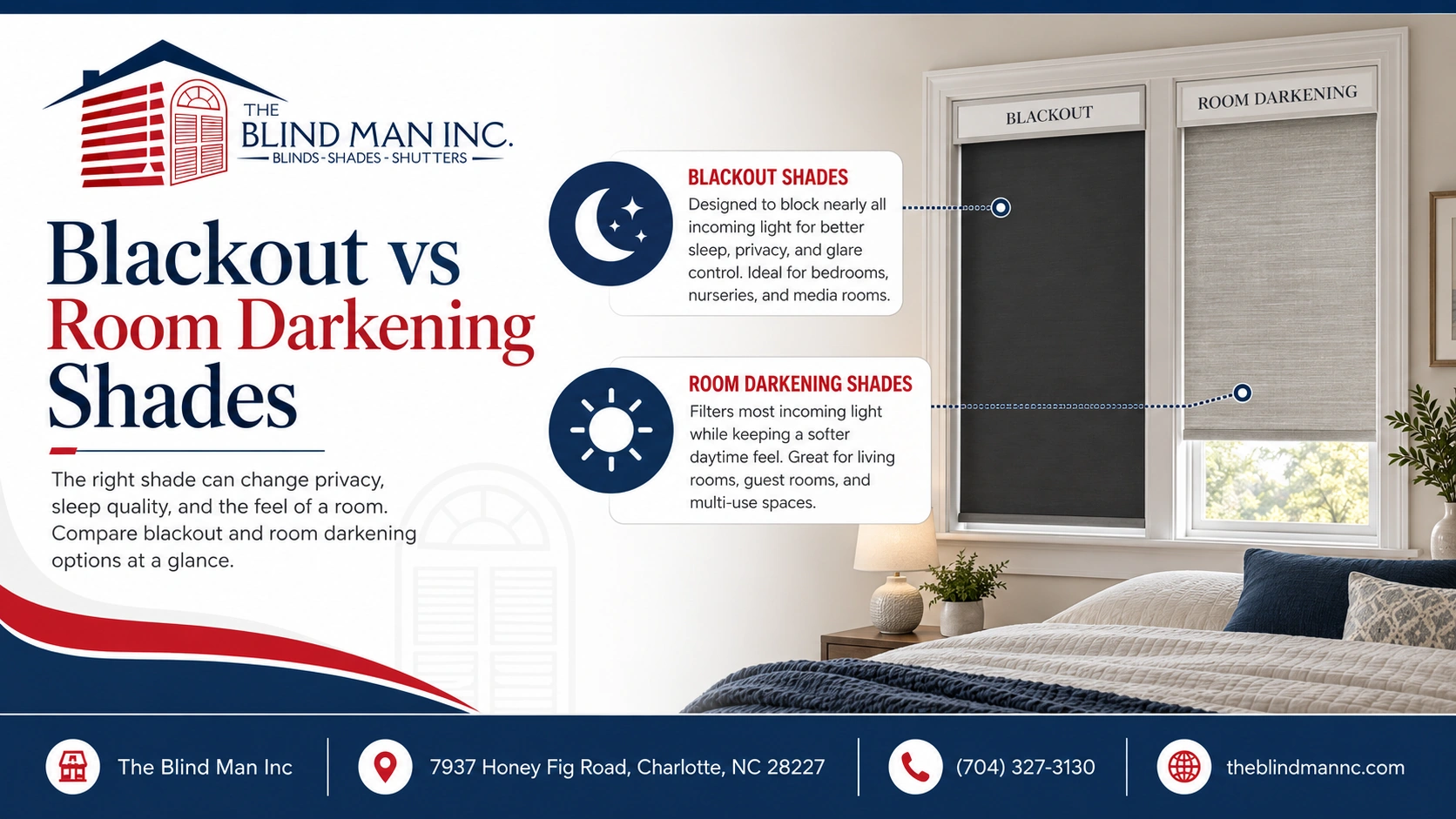
Blackout shades are designed to block nearly all incoming light, while room-darkening shades reduce a large amount of light without making a room completely dark. The better option depends on how much light control, privacy, insulation, and flexibility you need in a particular space.
For homeowners comparing blackout vs room darkening shades, the biggest mistake is assuming the two terms mean the same thing. They often use similar fabrics and operating styles, but they create noticeably different results. A nursery or media room may benefit from near-total darkness, while a living room may feel more comfortable with softer light reduction instead of complete blackout.
Blackout vs Room Darkening Shades: What Is the Difference?
The main difference comes down to how much light each treatment is designed to block.
Blackout shades use dense or specially coated materials intended to prevent almost all visible light from passing through the fabric itself. When they are properly fitted, they can create a very dark room even during daylight hours.
Room-darkening shades are less restrictive. They reduce a significant amount of sunlight and glare but usually allow some light to pass through the material or around the edges.
In practical terms:
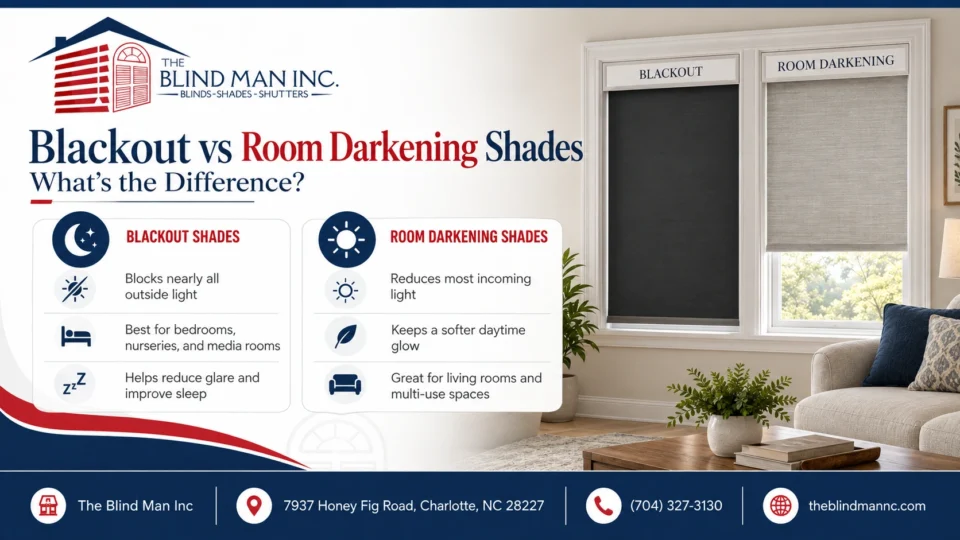
- Blackout shades are designed for maximum darkness.
- Room-darkening shades reduce brightness without eliminating daylight entirely.
- Blackout fabrics tend to be denser or more opaque.
- Room-darkening fabrics may allow a faint glow through the shade.
- Both can improve privacy.
- Both can help reduce solar heat entering the room.
- Actual performance depends on fabric, shade style, fit, and installation.
It is also important to understand that blackout fabric does not automatically guarantee a completely dark room.
Light may still enter around the sides, top, or bottom of the shade if gaps remain around the window. Homeowners who want the darkest possible result may need side channels, a carefully measured inside mount, an outside mount with additional overlap, or another light-blocking configuration.
Room-darkening treatments are generally more forgiving because complete darkness is not the goal.
How Much Light Do Blackout Shades Block?
Blackout shades are designed to block nearly all direct light passing through the material.
The exact amount varies by product, but high-quality blackout fabrics are typically made with opaque layers or backing that prevent sunlight from passing directly through the shade.
That makes them useful when homeowners want to:
- Sleep during daylight hours
- Reduce early morning sunlight
- Create a darker nursery
- Improve television or projector viewing
- Reduce glare on screens
- Increase privacy
- Limit heat from intense sunlight
The installation matters just as much as the fabric.
A blackout shade that fits inside a window opening may still leave narrow gaps along the sides where light can enter. This is sometimes called a light gap.
In a standard bedroom, a small amount of edge light may not matter. In a nursery, home theater, or bedroom used by a night-shift worker, those gaps may be much more noticeable.
Homeowners looking for maximum darkness should therefore consider both the material and mounting method.
An outside-mounted blackout shade can extend beyond the window opening and reduce the amount of light that escapes around the perimeter. Some specialized systems also use channels along the sides to further limit light leakage.
How Much Light Do Room Darkening Shades Block?
Room-darkening shades reduce a substantial amount of incoming sunlight but usually do not create total darkness.
Their purpose is to make a room noticeably dimmer while maintaining a softer, more natural environment.
During the daytime, a room-darkening shade may allow a muted glow through the window even when fully closed.
That can be useful in spaces where homeowners want reduced glare and increased privacy without creating the closed-off feeling that can come with complete blackout.
Room-darkening shades are often appropriate for:
- Living rooms
- Family rooms
- Dining areas
- Home offices
- Guest bedrooms
- Playrooms
- Rooms with strong afternoon sun
They can also be a practical compromise for households where different people have different preferences.
For example, one homeowner may prefer a dark bedroom for sleeping, while another finds complete darkness uncomfortable. A room-darkening shade can reduce early morning brightness while still allowing some ambient light into the room.
The amount of light that remains will depend on fabric density, color, window direction, and mounting style.
Which Option Is Better for Bedrooms?
Blackout shades are usually the stronger choice when sleep quality and light control are top priorities.
Even relatively small amounts of morning sunlight can make a bedroom feel brighter than expected, especially when windows face east or receive direct sunlight.
Blackout treatments can be especially useful for:
Shift Workers
People who sleep during daylight hours usually need stronger light control than someone following a typical nighttime sleep schedule.
Blackout shades can make a bedroom significantly darker during the day.
Nurseries and Children’s Rooms
Parents may choose blackout shades to create a more consistent sleep environment for naps and early bedtimes.
A darkened room can also reduce disruption from long summer evenings or bright mornings.
Light-Sensitive Sleepers
Some people wake easily when sunlight begins entering the room.
Blackout shades can help maintain a darker sleeping environment until the shade is raised.
Bedrooms With Street Lighting
Blackout materials can also reduce the effect of exterior lighting, including streetlights, landscape lighting, and neighboring properties.
Room-darkening shades may still work well in bedrooms when complete darkness is unnecessary.
Guest bedrooms, for example, may benefit from room darkening because the treatment provides strong privacy and reduced brightness while maintaining a more versatile atmosphere.
Which Shades Work Best for Living Rooms and Media Rooms?
Living rooms and media rooms have very different light-control requirements.
For most living rooms, room-darkening shades provide greater flexibility.
They can reduce glare, soften strong sunlight, and improve privacy while allowing the room to retain some natural brightness.
This is particularly useful in living spaces that are used throughout the day.
Completely blocking daylight every time the shade is lowered may make the space feel unnecessarily dark.
Room-darkening shades can work well for:
- Family rooms with televisions
- Living rooms facing busy streets
- Rooms with intense afternoon sun
- Spaces where furniture needs UV protection
- Areas where moderate privacy is needed during the day
Media rooms are different.
Blackout shades are generally the better choice when the space is used for movies, gaming, or projection systems.
Strong sunlight can wash out television and projector images, creating glare and reducing picture quality. Blackout treatments give homeowners much greater control over the viewing environment.
For multipurpose rooms, homeowners may also consider layered window treatments.
For example, a light-filtering or room-darkening shade can handle normal daytime use, while a separate blackout layer provides maximum darkness when needed.
How Do Blackout and Room Darkening Shades Compare for Privacy?
Both options can provide strong privacy, but blackout shades generally offer the highest level.
Because blackout material is opaque, people outside usually cannot see through the fabric when the shade is closed.
This makes blackout treatments particularly useful for:
- Bedrooms
- Bathrooms
- Street-facing rooms
- Ground-floor windows
- Rooms close to neighboring homes
Room-darkening shades can also offer excellent privacy, but homeowners should pay attention to the specific fabric.
Some fabrics that appear private during daylight may behave differently at night when interior lights are turned on.
The safest approach is to evaluate both daytime and nighttime privacy.
Homeowners concerned about privacy should also consider mounting gaps.
Even an opaque shade can leave small viewing angles around the sides if it does not extend far enough beyond the glass.
Professional measuring can help reduce those gaps and improve overall coverage.
Which Option Offers Better Energy Efficiency?
Both blackout and room-darkening shades can help improve comfort around windows, but performance depends more on construction than the label alone.
Dense fabrics can reduce solar heat entering the room and create an additional layer between the glass and interior space.
Blackout shades often perform well because their materials are thick and opaque.
During hot weather, they can reduce direct sunlight that would otherwise heat flooring, furniture, and surrounding surfaces.
They may be particularly useful in:
- West-facing rooms
- Large bedrooms
- Upper-floor rooms
- Media rooms with substantial glass
- Spaces that become uncomfortable during afternoon sun
Room-darkening shades can also reduce heat gain significantly.
Homeowners who do not need total darkness can still achieve meaningful solar control by selecting tightly woven or reflective room-darkening materials.
Shade construction matters too.
Cellular blackout shades, for example, can combine room-darkening performance with insulating air pockets inside their honeycomb structure.
Similarly, a well-fitted roller shade may perform differently from a loosely mounted treatment made with the same fabric.
For energy efficiency, homeowners should consider the entire product rather than choosing solely based on whether it is labeled blackout or room darkening.
Can Blackout and Room Darkening Shades Be Motorized?
Yes. Both blackout and room-darkening shades are available with motorized operating systems.
Motorization can be particularly practical for large, tall, or difficult-to-reach windows.
Depending on the system, homeowners may be able to operate shades using:
- A handheld remote
- Wall-mounted controls
- Smartphone applications
- Timed schedules
- Compatible smart-home platforms
- Voice-controlled systems
Motorization can also improve convenience in bedrooms and media rooms.
For example, blackout shades can be scheduled to close automatically in the evening and open gradually in the morning.
In a media room, multiple shades may be controlled simultaneously rather than adjusting each window individually.
Motorization does not change whether the fabric is blackout or room darkening. It simply changes how the shade is operated.
Homeowners should therefore choose the appropriate light-control material first and then decide whether manual or motorized operation makes more sense.
How to Choose the Right Shade for Your Room
The best way to compare blackout vs room darkening shades is to think about how each room is actually used.
Start With the Amount of Darkness You Need
Ask yourself whether you want the room to be completely dark or simply less bright.
Choose blackout when darkness is the priority.
Choose room darkening when you want strong light reduction without eliminating all ambient daylight.
Consider the Room’s Purpose
Different spaces have different requirements.
Blackout shades often make sense for:
- Primary bedrooms
- Children’s bedrooms
- Nurseries
- Home theaters
- Media rooms
- Bedrooms used by shift workers
Room-darkening shades are often better suited for:
- Living rooms
- Dining rooms
- Home offices
- Family rooms
- Guest rooms
- Multipurpose spaces
Evaluate Window Direction
Sun exposure can change dramatically depending on which direction a window faces.
East-facing windows often receive strong morning sunlight, while west-facing windows may become very bright and warm in the afternoon.
Rooms receiving intense direct sun may benefit from stronger light-blocking materials.
Think About Privacy
Ground-level windows and rooms facing sidewalks or neighboring homes generally need greater privacy.
Both shade types can provide privacy, but homeowners should confirm whether the room-darkening fabric remains opaque when interior lights are turned on.
Consider Energy Efficiency
If heat control is a priority, look beyond the fabric label.
Consider shade construction, window fit, mounting method, and insulating properties.
A cellular shade with blackout fabric may provide very different thermal performance from a basic roller shade.
Pay Attention to Mounting Style
Inside-mounted shades create a clean appearance but can leave narrow light gaps.
Outside-mounted shades can overlap the window opening and often provide better overall light coverage.
The best choice depends on the window depth, trim, architecture, and desired appearance.
Decide Whether Motorization Adds Value
Motorization may be worthwhile for:
- Large windows
- Tall windows
- Hard-to-reach areas
- Multiple shades
- Smart-home environments
- Bedrooms where automated schedules are helpful
For smaller, easily accessible windows, manual controls may remain perfectly practical.
The most effective window treatment is not necessarily the one that blocks the most light. It is the one that provides the right combination of darkness, privacy, comfort, appearance, and everyday convenience for that particular room.
FAQs
Are blackout shades completely dark?
Blackout fabrics are designed to block nearly all light passing through the material, but small amounts of light may still enter around the edges. Proper measurement, mounting, and optional side channels can reduce these gaps.
Are room-darkening shades the same as blackout shades?
No. Room-darkening shades significantly reduce incoming light but generally allow some ambient light to remain. Blackout shades are designed to create a much darker environment.
Which is better for a nursery, blackout or room darkening?
Blackout shades are commonly preferred for nurseries because they provide stronger light control during daytime naps and early bedtimes. Proper installation is important if maximum darkness is desired.
Can people see through room-darkening shades at night?
It depends on the fabric. Many room-darkening fabrics provide strong privacy, but some materials may reveal shadows or silhouettes when interior lights are on. Homeowners should check nighttime privacy before choosing a fabric.
Do blackout shades make a room cooler?
Blackout shades can help reduce solar heat by blocking direct sunlight, particularly on windows that receive intense sun. Their effect on temperature depends on the fabric, shade construction, fit, and window characteristics.
Are blackout shades only useful in bedrooms?
No. They are also useful in home theaters, media rooms, nurseries, photography spaces, and any room where strong glare or direct sunlight is a problem.
Can room-darkening shades still reduce glare on a television?
Yes. Room-darkening shades can substantially reduce glare and may be sufficient for everyday television viewing. For projector rooms or spaces where maximum image control is important, blackout shades are generally more effective.
Can blackout and room-darkening shades be customized?
Yes. Both options are available in a variety of fabrics, colors, mounting styles, operating systems, and motorized configurations. Professional measurement can help improve fit, light control, and overall appearance.
Share this article
Latest articles
September 9, 2026

September 9, 2026

September 9, 2026